
Crowdfunding and P2P Lending Platform Development in Dubai (2026): Licences, Investor Caps and Real AED Build Costs
SMEs are 94% of UAE companies but get just 3.5% of bank credit. What it takes to launch a licensed crowdfunding or P2P lending platform in Dubai, plus real AED build costs.
- PUBLISHED
- 21 OCT 2026
- READ TIME
- 12 MIN
- AUTHOR
- AQUARIUS · DUBAI
- UNIT
- REV 2026.09
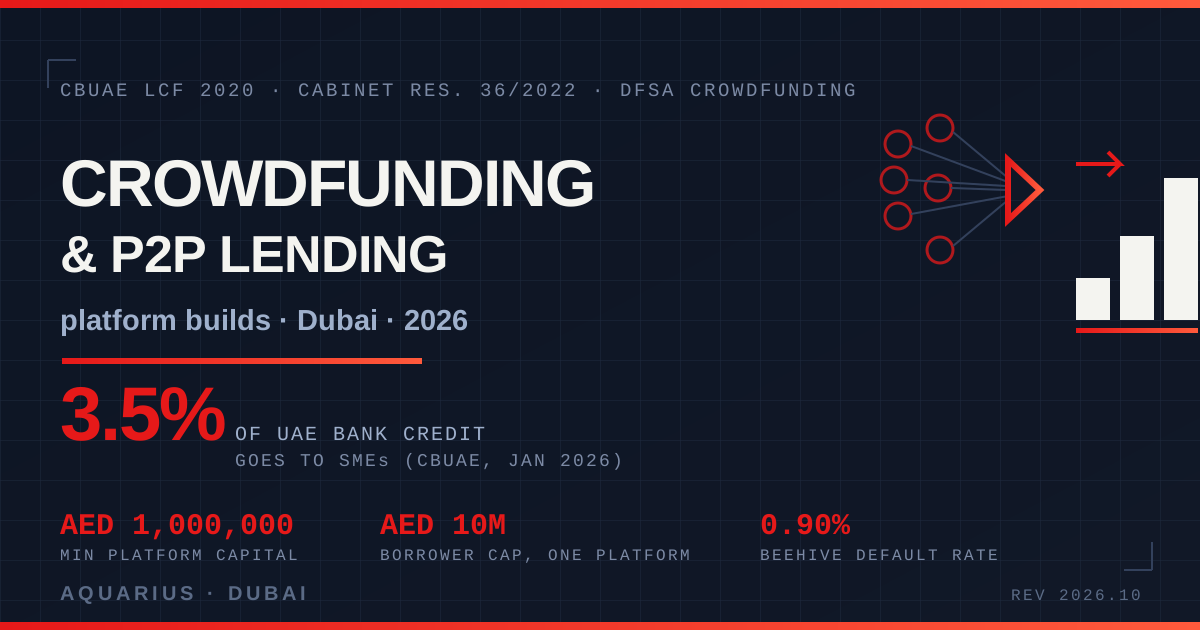
Short answer: A crowdfunding or peer-to-peer lending platform in Dubai is a regulated product before it is a software product, and the regulator you answer to decides what you build. Loan-based platforms onshore fall under the Central Bank's Loan-based Crowdfunding Activities Regulation: minimum capital AED 300,000 for a small platform, AED 1 million once cumulative annual lending passes AED 5 million. Equity crowdfunding sits with the SCA under Cabinet Resolution No. 36 of 2022 at AED 1 million paid-up capital, while the DFSA licenses loan, investment and property crowdfunding inside the DIFC on USD 140,000 base capital. The build itself lands between AED 85,000 and AED 650,000 depending on whether you need one investor portal or a full regulated-grade platform with segregated client money and regulatory reporting.
The number that explains why these platforms exist
Small and medium businesses are the UAE economy. They are also the part of it that banks barely lend to.
- SMEs make up roughly 94 to 95% of all companies operating in the UAE and contribute about 63.5% of non-oil GDP. EY counted 557,000 SMEs in 2022, and national policy targets one million by 2030.
- Against that, Central Bank figures cited in January 2026 put funded SME lending at AED 92.0 billion out of AED 2.6 trillion of gross bank credit — roughly 3.5%. On the narrower commercial-and-industrial denominator the share looks better, 9.5% in the first half of 2024 on AED 81.2 billion of facilities, but either way the gap is structural, not cyclical.
- Across MENA, SMEs receive about 7% of total bank credit, and the regional SME credit gap is estimated at USD 475 billion.
- A Central Bank survey found 75% of UAE SMEs described themselves as financially constrained, yet only 17% had approached a bank for credit — and of those, around half succeeded.
- The money has started routing around the banks. The UAE crowdfunding market generated USD 46.0 million in revenue in 2024 and is forecast to reach USD 118.7 million by 2030, a 17.5% CAGR, with debt-based crowdfunding the largest segment and equity the fastest growing.
Most founders pitching a Dubai crowdfunding platform get the order wrong. They build the marketplace, then go looking for a licence. In the UAE the licence category dictates the data model, the money flow and half the screens — so it has to be settled in week one, not month nine.
Proof the model works here: the Beehive numbers
Beehive, the DIFC-based loan crowdfunding platform, publishes its book. As at 31 July 2026 it reported over AED 4 billion funded to date (AED 3,974.86 million), 40,957 funding requests financed and more than 2,000 investors. Net returns to investors in 2026 ran at 13.36% on term finance and 11.30% on working capital finance, with an overall default rate of 0.90%, an average NPL ratio under 2% and 87% of principal recovered to date.
Those are the three numbers your platform has to produce on demand: net return by product and vintage, default rate, and recovery. If the reporting layer cannot generate them per cohort, you have built a payments app with a listings page — and no institutional investor will allocate to it.
Three regulators, three different products
This is the part that gets scoped wrong. "Crowdfunding platform" in the UAE is not one licence; it is at least three, with different capital floors, different permitted borrowers and different investor caps that have to be hard-coded into your product rules.
| Route | Regulator / instrument | Minimum capital | What it covers |
|---|---|---|---|
| Loan-based, onshore | CBUAE — Loan-based Crowdfunding Activities Regulation, issued 14 October 2020 | AED 300,000 (Category 2, under AED 5m cumulative annual loans); AED 1,000,000 (Category 1, AED 5m and above) | Debt and invoice-style finance to UAE businesses |
| Equity / investment, onshore | SCA — Cabinet Resolution No. 36 of 2022 on the crowdfunding platform activity | AED 1,000,000 paid-up | Shares and investment-based raises by onshore companies |
| Loan crowdfunding, DIFC | DFSA crowdfunding rules | USD 140,000 base capital (about AED 514,000) | Corporate borrowers only — no individual borrowers |
| Investment crowdfunding, DIFC | DFSA crowdfunding rules | USD 140,000 base capital | Equity raises, with a separate property crowdfunding permission |
Two capital details catch teams out. Under the Central Bank regulation a loan-based platform must hold the higher of its minimum capital or 5% of outstanding lending volume — a number that grows with the book, so it belongs on the product roadmap, not just the balance sheet. And in the DIFC, base capital is a floor: the DFSA sets the real figure against forecast annual expenditure in your financial model.
The limits your code has to enforce, not just document
- Onshore equity (SCA): a retail investor is capped at AED 30,000 in any single project and AED 100,000 across all projects in a rolling 12 months. That is a per-investor running total with a moving window — real engineering, not a checkbox.
- DIFC loan crowdfunding (DFSA): retail investors may commit up to USD 50,000 per calendar year and no more than USD 5,000 to a single borrower. Serving retail at all requires a Retail Endorsement, priced around USD 20,000.
- Borrower side (CBUAE): a borrower may list on only one platform and borrow a maximum of AED 10 million through loan-based crowdfunding. Onboarding needs a declaration, and the credit file needs to evidence the check.
- AML thresholds: enhanced due diligence applies above AED 500,000 and to politically exposed persons, with suspicious-activity reporting through goAML. Our guide to AML and KYC compliance software in Dubai covers that plumbing.
- Credit data: licensed UAE lending platforms integrate with Etihad Credit Bureau, report inquiries and active borrowing, and consume a score on the 300 to 900 range that now folds in cheque clearance history, payslips and utility payments.
What actually has to be in the build
Strip away the marketing site and a UAE crowdfunding platform is six systems wearing one domain name:
- Onboarding and eKYC — Emirates ID and passport capture, liveness, UAE Pass where it fits, corporate KYB with trade licence and ultimate-beneficial-owner mapping, sanctions and PEP screening, and investor classification (retail, professional, institutional), because the caps above depend on it.
- Origination and credit assessment — borrower application, document ingestion, bank-statement and VAT-return analysis, Etihad Credit Bureau pull, a scorecard with a recorded decision reason, and a credit-committee workflow with an audit trail. Open banking shortens this: see Open Finance and Al Tareq API integration in Dubai.
- Deal and campaign engine — listing lifecycle, tranching, auction or fixed-rate pricing, commitment and allocation logic, oversubscription handling, and the cancellation window.
- Client money and payments — a segregated collection account, investor wallets, drawdown, repayment schedules, direct-debit mandates, late-payment and recovery states, and investor payouts. Client money held apart from operating cash is not a nice-to-have; it is the first thing a regulator looks at.
- Investor reporting and tax — statements, net-return and default calculations per cohort, certificates, and 5% VAT handled correctly on platform fees with a TRN-bearing invoice.
- Regulatory and risk reporting — periodic returns, outstanding-lending-volume tracking against the 5% capital rule, incident logs, and an immutable audit trail for every decision touching a borrower or an investor.
Layer PDPL over all of it. You are processing Emirates ID numbers, bank statements, credit files and income data — about as sensitive as a UAE dataset gets. Lawful basis per processing purpose, data minimisation on the application form, role-based access so a marketing user cannot read a credit file, retention limits, and a 72-hour breach path. The full list is in our UAE PDPL compliance checklist.
Buy or build: run the fee maths before you sign
White-label crowdfunding software is real and sometimes right. What kills it in the UAE is the combination of recurring licence fees, transaction percentages and the regulatory gaps you still have to fill yourself. Published vendor pricing:
| Vendor | Published price | Approx. AED | Watch out for |
|---|---|---|---|
| CrowdEngine | USD 1,495 / month + USD 15 per investment | ~5,490 / month | Per-investment fee punishes small-ticket retail |
| DealMaker | USD 20,500 activation + USD 2,000 / month + 8.5% of proceeds | ~75,300 setup + ~7,350 / month | The 8.5% is the whole decision |
| White Label Crowdfunding | GBP 2,500 to 5,500 / month, 3 to 6 months paid in advance | ~11,600 to 25,500 / month | Mobile app add-on GBP 9,500; bespoke design GBP 2,000 |
| TurnKey Lender | From USD 500 / month | ~1,840 / month | Entry tier; scales with modules and volume |
| SyndicationPro | USD 400 to 600 / month + USD 95 per user | ~1,470 to 2,200 / month | Built for US syndications, not UAE caps |
| Custom build, global benchmark | USD 45,000 to 230,000+ | ~165,000 to 845,000 | Wide because scope is wide — see the AED bands below |
Here is the arithmetic most Dubai founders only do after signing. On a platform that funds AED 20 million in a year, an 8.5% transaction fee is AED 1.7 million — plus activation and the monthly. Beehive has funded over AED 4 billion; at that scale percentage-of-proceeds pricing is not a cost line, it is your business model, handed over. Owning the platform usually pays back somewhere between the first AED 5 million and AED 15 million funded, and before that a white-label is genuinely the cheaper way to test demand.
Real AED build costs in Dubai, 2026
| Scope | Cost (AED) | Typical timeline |
|---|---|---|
| Investor-facing MVP — one asset class, manual onboarding and payouts | 85,000 – 160,000 | 6 – 10 weeks |
| Dual-sided platform — borrower portal, investor portal, deal and allocation engine | 180,000 – 340,000 | 3 – 5 months |
| Regulated-grade build — segregated client money, capital-adequacy tracking, regulatory returns, full audit trail | 340,000 – 650,000 | 5 – 9 months |
| eKYC, KYB, sanctions and PEP screening, goAML reporting | 35,000 – 90,000 | 3 – 6 weeks |
| Credit decisioning — Etihad Credit Bureau, open finance, scorecards | 45,000 – 120,000 | 4 – 8 weeks |
| Payments, mandates, wallets and payout rails | 40,000 – 110,000 | 4 – 8 weeks |
| Arabic and English, full RTL | 15,000 – 35,000 | 2 – 3 weeks |
| Investor mobile app (iOS + Android) | 70,000 – 150,000 | 8 – 12 weeks |
| Ongoing care — monitoring, reporting changes, regulatory updates | 6,000 – 18,000 / month | Retainer |
Licensing runs in parallel and is its own budget line. In the DIFC, published figures sit around a USD 5,000 application fee with a USD 10,000 annual licence at one end and USD 10,000 on application with USD 15,000 annually from year two at the other, plus roughly USD 20,000 for a Retail Endorsement — confirm current numbers with the DFSA, because they move. Expect 4 to 8 months to authorisation, and up to 12 if the model is novel. That window is exactly when the platform should be getting built, not after.
How Aquarius builds these
We start with the licence route, because it is the only decision that cannot be refactored later. Then we build in the order a regulator reads it: client money and audit trail first, origination and deal engine second, investor experience third. Fixed-scope phases, an AED number per phase, a working build in your hands every two weeks, and the compliance artefacts — data-flow maps, retention schedule, decision logs — produced as part of the build rather than reconstructed six months later. Indicative ranges are on our pricing page, and the licence-route workshop is free and takes about ninety minutes.
FAQ
Which regulator do I need — the Central Bank, the SCA or the DFSA?
Follow the instrument. Lending to UAE businesses onshore is Central Bank territory under the Loan-based Crowdfunding Activities Regulation. Selling shares or investment interests onshore is the SCA under Cabinet Resolution No. 36 of 2022. Operating from the DIFC, with corporate borrowers and often international investors, is the DFSA. Property crowdfunding in the DIFC carries its own permission.
How much capital do I need to launch?
AED 300,000 for a small Category 2 loan-based platform (under AED 5 million cumulative annual lending), AED 1 million once you cross that line, AED 1 million paid-up for SCA equity crowdfunding, and USD 140,000 base capital in the DIFC. Loan-based platforms must also hold the higher of minimum capital or 5% of outstanding lending volume, so capital scales with the book.
Can retail investors use my platform?
Yes, with hard caps. Onshore equity: AED 30,000 per project and AED 100,000 per rolling 12 months per retail investor. DIFC loan crowdfunding: USD 50,000 per calendar year and USD 5,000 per single borrower, and you need a Retail Endorsement to serve them at all. These limits have to be computed and enforced by the platform at commitment time.
Is white-label cheaper than building?
For the first few million funded, usually yes. Past that, percentage-of-proceeds pricing dominates everything else: 8.5% on AED 20 million funded is AED 1.7 million a year, against a dual-sided custom platform at AED 180,000 to 340,000 one-off. The other reason teams move off white-label is that UAE investor caps, Etihad Credit Bureau integration and goAML reporting are rarely supported out of the box.
How long before we can take the first investment?
Realistically 6 to 12 months end to end. Authorisation is the critical path at 4 to 8 months, with the platform built alongside it. A dual-sided build is 3 to 5 months, so teams that start engineering at in-principle approval usually launch within weeks of final authorisation instead of months after it.
Where to start
The UAE has an AED 92 billion SME lending book inside an AED 2.6 trillion credit market, a crowdfunding sector compounding at 17.5% a year, and a working local benchmark showing 13%-plus net investor returns at under 1% defaults. The opportunity is not in doubt. What separates platforms that launch from the ones that stall is picking the licence route first and treating client money, audit trails and investor caps as the product rather than a bolt-on.
If you are scoping a crowdfunding, P2P lending or invoice-finance platform for the UAE, send us the model and we will come back with the licence route, the module list and an AED range per phase. If you are earlier than that, our guide to fintech app development in Dubai across DIFC and ADGM is the right next read.