
Confidential Computing in Dubai 2026: Data Residency Is Not Data Protection
Your UAE data centre still lets the operator read your data in RAM. Confidential VMs close that gap - and on Azure UAE North they cost AED 0 extra. Live 2026 figures.
- PUBLISHED
- 23 OCT 2026
- READ TIME
- 13 MIN
- AUTHOR
- AQUARIUS · DUBAI
- UNIT
- REV 2026.09
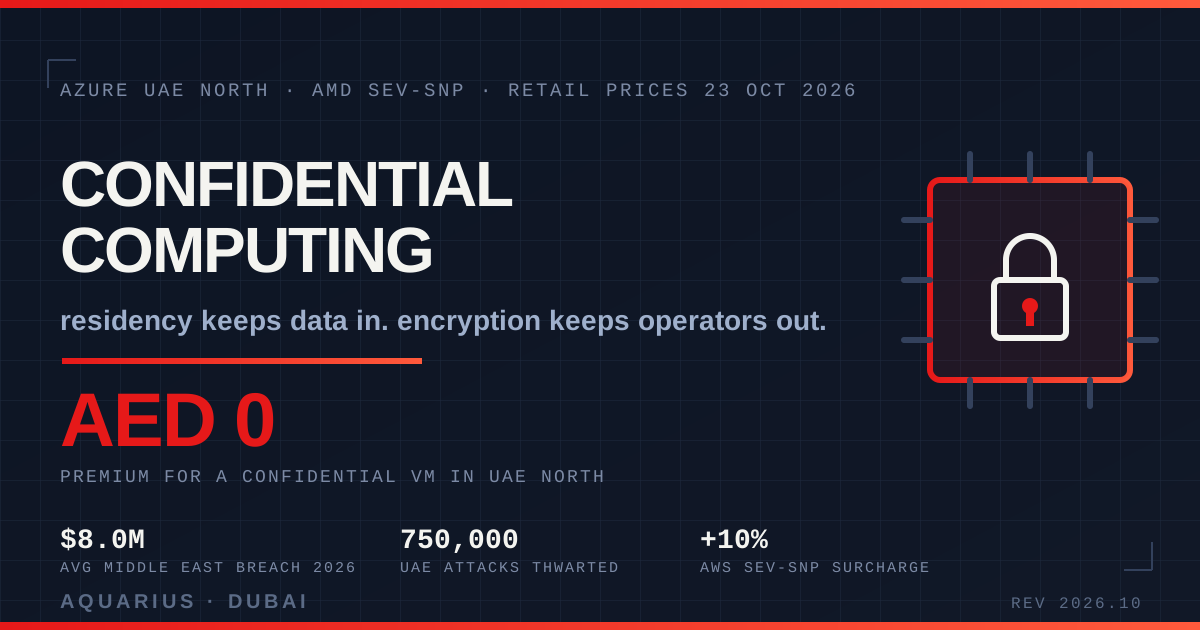
Data residency keeps your data inside the UAE. It does not stop the cloud operator, a compromised hypervisor, or a rogue administrator from reading it while it is being processed. Confidential computing closes that last gap by encrypting data in use — in RAM, inside a hardware-isolated enclave the host cannot see into. The surprise for Dubai buyers in 2026: on Azure UAE North it costs nothing extra. A confidential DC8as_v5 virtual machine lists at exactly the same $0.424 per hour as the standard D8as_v5 — about AED 1,137 a month either way. Most Dubai businesses are paying for residency and assuming they bought protection.
The stakes: AED 29 million per breach, 750,000 attacks stopped
The Middle East is now the second most expensive region in the world to get breached. IBM's 2026 Cost of a Data Breach report puts the regional average at USD 8.0 million — roughly AED 29.4 million at the pegged rate of 3.6725. The damage is not mostly forensics. Lost business accounts for USD 3.57 million, post-breach response USD 2.17 million, and detection and escalation USD 1.9 million. Financial services and technology firms average USD 10.67 million each.
The single largest cost amplifier IBM identified was mismanaged secrets and encryption keys. That is a data-in-use problem wearing a key-management costume: keys have to be decrypted into memory to be used, and memory is exactly where most architectures have no protection at all.
The attack volume is not theoretical either. The UAE Cyber Security Council reported in October 2026 that it detected and thwarted approximately 750,000 cyberattack attempts, with energy and education the most-targeted sectors and remote code execution, DDoS, phishing and AI-assisted attacks leading the mix. IBM found 26% of malicious breaches were AI-enabled, with a further 11% undetermined.
Meanwhile the UAE cloud market is compounding at 27.93% a year, from USD 16.43 billion in 2026 to a projected USD 56.26 billion by 2031. More regulated workloads are moving to shared infrastructure every quarter, and the question of who can read them in flight is getting louder.
The myth: three states of data, and residency only covers two
Every compliance conversation in Dubai covers encryption at rest and encryption in transit. Both are solved problems — TLS 1.3 on the wire, AES-256 on the disk, keys in a vault. Ask the third question and the room goes quiet.
Most Dubai businesses get this wrong in the same way: they treat "our data stays in the UAE" as the end of the sentence. A UAE data centre with an unprotected memory plane means your patient records, KYC files and payroll are sitting in plaintext RAM on hardware you do not control, in a country that happens to be this one.
To process data, the CPU must decrypt it. In a conventional virtual machine that plaintext lives in host memory, visible in principle to the hypervisor, the host kernel, a privileged operator with the right access, a memory-dump attack, or anything that achieves hypervisor escape. Residency controls geography. Confidential computing controls who can look. They are different purchases, and only one of them is usually on the invoice.
What a trusted execution environment actually does
Confidential computing runs the workload inside a hardware-enforced trusted execution environment (TEE). On AMD EPYC processors this is SEV-SNP (Secure Encrypted Virtualization with Secure Nested Paging); on Intel it is TDX (Trust Domain Extensions). The mechanics that matter commercially:
- Memory encryption with per-VM keys. The memory controller encrypts RAM pages with a key the hypervisor never holds. A host-side memory dump yields ciphertext.
- Integrity protection. SEV-SNP adds a reverse map table so the host cannot silently remap, replay or corrupt guest pages — the older SEV encrypted memory but did not stop tampering.
- Remote attestation. The CPU signs a report describing exactly what booted. On AMD that chain runs through a VCEK (dedicated) or VLEK (shared tenancy) certificate back to AMD's own root of trust. You verify it yourself — the cloud provider's assurances are not part of the proof.
- Attestation-bound keys. This is the part auditors like. You can write a key-management policy that releases the decryption key only to a workload whose attestation report matches a known-good measurement. If anything about the boot chain changed, the key never arrives and the data never decrypts. We cover the mechanics in secrets and key management for Dubai teams.
What you can actually buy for a UAE-resident workload in 2026
This is where the Dubai picture diverges sharply from the global marketing. We checked live retail pricing on 23 October 2026. Converted at AED 3.6725 per USD and 730 hours per month:
| Option | Available in UAE? | Premium vs standard compute | 2026 benchmark (AED/month) |
|---|---|---|---|
| Azure confidential VM, DC8as_v5 (AMD SEV-SNP), UAE North | Yes — UAE North | Zero ($0.424/hr, identical to D8as_v5) | ~AED 1,137 (Linux) / ~AED 2,123 (Windows) |
| Azure confidential memory-optimised, EC8as_v5, UAE North | Yes — UAE North | Zero ($0.56/hr, identical to E8as_v5) | ~AED 1,501 |
| Azure confidential VM, DC64as_v5, UAE North | Yes — UAE North | Zero ($3.392/hr, identical to D64as_v5) | ~AED 9,094 |
| Azure DCesv5 family (Intel TDX) | No UAE North meter | n/a in region | Not available in-region |
| AWS Nitro Enclaves (me-central-1, UAE) | Yes — all AWS regions | No additional charge | Cost of the parent instance only |
| AWS SEV-SNP, shared tenancy | No — US East (Ohio) and Europe (Ireland) only | +10% of On-Demand hourly, billed separately | Fails UAE residency |
| AWS SEV-SNP on Dedicated Hosts | Any commercial region | No extra charge for SEV-SNP | Dedicated Host rate (large step up) |
| Google Confidential VM (SEV-SNP, N2D) | No UAE region — nearest Doha / Dammam | +$0.0027502/vCPU-hour | Fails UAE residency |
Three conclusions a Dubai architect should take from that table. First, on Azure UAE North the AMD SEV-SNP premium is AED 0 — if you are deploying new VMs in the region and not picking the DC or EC family, you are declining free memory encryption. Second, Intel TDX is not offered in UAE North, so an in-country design is an AMD design. Third, AWS gives you Nitro Enclaves free in me-central-1, but its SEV-SNP shared-tenancy option is simply not sold in the UAE — if your AWS plan assumed it, the plan is wrong.
Nitro Enclaves solve a narrower, sharper problem: an isolated hardened VM carved out of a parent instance with no persistent storage, no external network, no interactive access, and no path for the parent's root user to reach in. Communication is local vsock only, up to four enclaves per parent. That makes it the right tool for key handling, payment tokenisation, PII de-identification and multi-party data joins — and the wrong tool for a general application server. Note that enabling SEV-SNP on an EC2 instance disables Nitro Enclaves and hibernation, is set only at launch, cannot be reversed, requires a UEFI-compatible AMI, and is limited to m6a, c6a and r6a families.
Where the regulators have already arrived
The UAE has not mandated confidential computing by name, but the direction of travel is unambiguous.
In February 2026 the Central Bank of the UAE and Core42 announced a sovereign financial cloud under the CBUAE's FIT Programme — described as the world's first dedicated financial cloud ecosystem of its kind. Core42's Sovereign Public Cloud runs on Azure UAE infrastructure and explicitly maps Azure confidential compute and the UAE National Cloud Security Policy to more than 200 technical controls. When the sovereign cloud a regulator blesses lists confidential compute as a building block, that is the reference architecture, not an exotic add-on.
Health data is stricter still. Federal Law 2/2019 bars storing, processing or transferring UAE health data outside the country without approval. The DHA requires UAE residency on Tier 3, DESC-certified infrastructure. Abu Dhabi's ADHICS standard — current version effective August 2024 — requires approval before health data goes to a cloud at all.
On personal data generally, Federal Decree-Law 45/2021 (PDPL) has been in force since January 2022, but as of October 2026 the Executive Regulations and the Cabinet decision setting administrative fines have still not been issued. Anyone quoting you a specific PDPL penalty figure is inventing it. The honest risk model is the breach cost, not the fine: AED 29.4 million average, against an AED 0 premium on the control that removes the memory-plane attack surface. For the wider residency picture see our notes on Dubai hosting and data residency and private LLM deployment with UAE data residency.
What confidential computing does not fix
Being straight about the limits is what separates an architecture from a slogan. A TEE will not save you from:
- Your own application bugs. SQL injection inside an enclave returns the same rows. The data is encrypted against the host, not against your code.
- Stolen credentials. A valid token is a valid token. Attestation checks the machine, not the human.
- Unverified attestation. Running a DC-series VM and never validating the report is theatre. If nothing in your pipeline fails when the measurement changes, you have not deployed the control.
- Key custody confusion. If the provider still holds your key-release policy, the trust boundary has not moved. BYOK and HYOK with attestation-bound release is the point.
- Concentration risk. On 2 March 2026 an incident in AWS me-central-1 availability zone mec1-az2 — objects causing sparks and a fire, after which the fire department cut power and generators — spread to a loss of power in a second AZ and connectivity problems in a third, with AWS advising customers to relocate critical data and S3 showing high ingest and egress failure rates. In-country does not mean resilient. Plan the failure domain separately; see our AWS vs Azure UAE migration cost breakdown.
What it costs to do this properly in Dubai
The compute is free. The engineering is not, and that is the honest BOFU number. Typical Aquarius scoping ranges in 2026:
- Readiness assessment and data-state map — AED 12,000 to AED 22,000. Classify workloads, identify regulated data, confirm in-region TEE availability, produce the migration order.
- Lift a workload onto confidential VMs in UAE North — AED 25,000 to AED 60,000 per application, mostly image rebuild on a UEFI-compatible base, driver and agent validation, and regression testing. Run-rate change: typically zero.
- Attestation-bound key release — AED 35,000 to AED 75,000. Policy design, measurement baselining, CI integration so a changed boot chain blocks a deploy rather than quietly decrypting.
- Nitro Enclave for a key or tokenisation service — AED 45,000 to AED 110,000, depending on how much of the parent application has to be refactored around vsock-only I/O.
Set that against the arithmetic. IBM found organisations with extensive AI and automation in their security operations saved more than USD 3 million per breach versus those without. Around 59% of enterprises now say data-in-use protection is a priority. The cost-of-inaction line is simply the gap between an AED 0 per month control and an AED 29.4 million average incident — and the only thing standing between those two numbers is a rebuild sprint.
We do not ask Dubai clients to rip and replace. The sequence is boring on purpose: assess, move the highest-sensitivity workload first, prove attestation works in CI, then make the DC or EC family the default for every new VM in UAE North. See how we scope cloud and security work, or review our pricing.
FAQ
Does a confidential VM cost more than a normal VM in the UAE?
On Azure UAE North, no. Checked on 23 October 2026, DC8as_v5 and D8as_v5 both list at $0.424 per hour — about AED 1,137 a month — and DC64as_v5 matches D64as_v5 at $3.392 per hour. On AWS, Nitro Enclaves carry no additional charge in any region including me-central-1, but shared-tenancy SEV-SNP adds 10% of the On-Demand hourly rate and is not sold in the UAE at all.
Is confidential computing required by UAE law?
Not by name. PDPL 45/2021 requires appropriate technical measures but its Executive Regulations and fine schedule were still unissued as of October 2026. Sector rules are firmer: Federal Law 2/2019 for health data, DHA Tier 3 DESC-certified residency, and ADHICS approval in Abu Dhabi. The CBUAE and Core42 sovereign financial cloud already lists Azure confidential compute among its mapped controls, which is the clearest signal of where supervisory expectations are heading.
Can I use Google Confidential VM for a UAE workload?
Not if residency matters. Google publishes confidential computing add-on rates — AMD SEV at $0.005479 per vCPU-hour, SEV-SNP at $0.0027502, Intel TDX at $0.0033982 — but has no UAE region. The nearest are Doha and Dammam, which does not satisfy a UAE residency requirement.
What is the difference between a confidential VM and a Nitro Enclave?
A confidential VM protects an entire ordinary virtual machine's memory, so most applications run unmodified. A Nitro Enclave is a small, hardened, network-isolated compartment inside a parent instance with no persistent storage and vsock-only communication — a much stronger boundary for a much narrower job, like key operations or tokenisation, and it usually requires splitting your application.
How do I know the protection is actually switched on?
Verify the attestation report, do not trust the SKU name. Fetch the signed report from the TEE, validate the certificate chain to the silicon vendor's root, compare the measurement against your known-good value, and make your key-management policy release the data key only on a match. If a tampered boot chain does not break a deployment in your pipeline, the control is decorative.
If your Dubai workload holds patient records, KYC files, payroll or anything a regulator would ask about, the data-in-use question is now the cheapest one on the list to answer. Tell us what you run and where and we will map which of your workloads can move to a confidential VM this quarter at no change in run-rate.