
Cold Chain Monitoring Software in Dubai (2026): IoT Loggers, GDP Rules and Real AED Build Costs
What cold chain temperature monitoring really costs in Dubai: AED build ranges, Dubai Food Code 5C and -18C bands, MOHAP GDP five-minute logging and the sensor maths behind the budget.
- PUBLISHED
- 02 OCT 2026
- READ TIME
- 12 MIN
- AUTHOR
- AQUARIUS · DUBAI
- UNIT
- REV 2026.09
Short answer: A cold chain monitoring system in Dubai costs roughly AED 90,000–160,000 for a single-site chilled/frozen store with alerting and audit-ready logs, AED 180,000–380,000 for a multi-site plus reefer-fleet platform, and AED 350,000–650,000 for a MOHAP-GDP-grade pharma build with validation documentation. Hardware adds roughly AED 165–400 per wireless sensor and AED 850–4,200 per gateway.
What you are actually buying is evidence. Dubai Municipality treats temperature logs as the primary proof that chilled food stayed at or below 5°C and frozen food at or below -18°C, and MOHAP's Good Distribution Practice rules expect calibrated electronic loggers with a documented audit trail from loading to delivery. A reefer that works but cannot prove it worked fails the inspection anyway.
Why Dubai operators are buying this in 2026
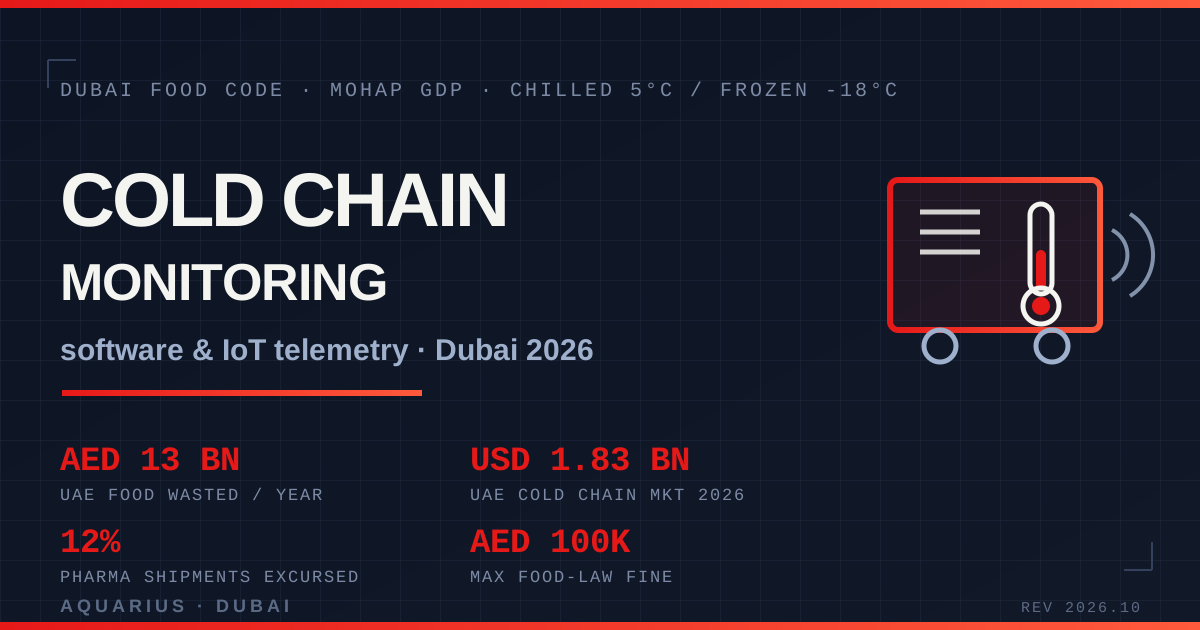
Three numbers set the stakes. First, the UAE imports roughly 90% of its food — about 16.9 million tonnes in 2022 — so almost every calorie sold here has already survived a port, a bonded store and a truck before it reaches a shelf. Second, the country wastes around 3.2 million tonnes of food a year, worth about AED 13 billion, with inadequate cold storage and distribution delays named as direct drivers. Third, the UAE cold chain logistics market is growing from roughly USD 1.65 billion in 2025 to USD 1.83 billion in 2026 (Mordor Intelligence), on its way to about USD 2.43 billion by 2031.
The gap is instrumentation, not refrigeration. Industry estimates put 20–30% of UAE food-supply trucks and delivery wagons as still needing telematics fitted, and intelligent logistics with real-time checks is credited with recovering around 5% of food loss. On the pharma side the arithmetic is harsher: roughly 12% of pharmaceutical shipments experience a temperature excursion in transit or storage, and the FDA has estimated the industry loses about USD 35 billion a year to cold chain failures.
Most Dubai businesses get this wrong in the same way: they buy better fridges and trucks, then keep recording temperatures on a clipboard twice a shift. The asset was never the weak link — the record was.
What Dubai regulators actually require
Before you scope software, pin down which rulebook you are inspected against. Most Dubai operations fall under one or both of the following.
Food: Dubai Municipality Food Code and DMChecked
The Dubai Food Code sets the holding and transport bands: perishable chilled food at a maximum of 5°C, frozen cargo at -18°C or below at all times, and hot ready-to-eat food held continuously at a minimum of 60°C from kitchen to customer. Dubai Municipality's transport and delivery vehicle guidelines add two operational rules software has to respect: monitoring devices in refrigerated vehicles must be calibrated, and the cooling unit must stay on at all times, including standby, until every item is unloaded.
On 12 November 2025 Dubai Municipality launched DMChecked, replacing FoodWatch Connect, and every DM-licensed restaurant, café, catering unit, central kitchen, food factory and delivery vehicle now operates inside it. Breaching technical regulations under the Food Safety Law exposes a business to fines of AED 10,000 to AED 100,000, doubled for repeat violations, and inaccurate food-safety records can attract AED 50,000 to AED 100,000 for serious cases. If kitchen-side checklists are your main concern, read our companion guide on food safety compliance software and DMChecked — this article is about the sensors and the chain between sites.
Pharma: MOHAP, DHA and GDP
Most cold chain medicines move at 2–8°C, with frozen biologics colder. Good Distribution Practice — enforced via MOHAP, DHA and DoH Abu Dhabi depending on licence — expects calibrated electronic data loggers sampling at intervals of five minutes or shorter, a documented audit trail from loading to delivery, and trained drivers. When an excursion happens the product must be quarantined immediately, the event documented, and a qualified person must rule on it against manufacturer stability data; with no stability data, the stock is rejected. Your software is the thing that makes that workflow fast instead of a two-day email hunt.
What a cold chain monitoring platform is made of
Five layers, and the cost sits in different places than most buyers expect.
- Sensors. Battery-powered wireless probes for cold rooms, chillers, freezers, reefer bodies and shipping containers. Industrial LoRaWAN nodes run about USD 45–99 each (AED 165–365), are commonly IP67-rated, and last 3–5 years on a battery.
- Connectivity. A LoRaWAN gateway per site (roughly EUR 200–1,000, i.e. AED 850–4,200) with no per-sensor airtime fee because it runs on unlicensed ISM spectrum. Vehicles use a GSM/GPS telematics unit instead, so there is a monthly SIM cost per truck.
- Ingest and storage. A time-series backend that accepts readings every 1–5 minutes, never overwrites history, and keeps raw data for the retention your inspector expects.
- Alerting. Threshold plus duration rules (a freezer door open for 90 seconds is not an excursion; 40 minutes is), escalation to WhatsApp, SMS or phone, and acknowledgement tracking so an alert cannot quietly die at 2am.
- Evidence and workflow. Per-asset and per-consignment temperature charts, calibration certificates on file, excursion case records with corrective action, and one-click PDF or Excel exports for a DM or MOHAP inspector.
UAE vendors already sell packaged versions — published local pricing includes around AED 2,000 for a cold chain monitoring setup and AED 3,500 for multi-zone warehouse monitoring — which is the right answer for a single store with simple needs. Custom development earns its keep when you need consignment-level proof, ERP or WMS integration, Arabic-English operator screens, or a client portal your own customers log into.
Indicative AED build costs
| Scope | What you get | Typical build (AED) | Hardware per site/vehicle |
|---|---|---|---|
| Single-site store monitor | Sensors, dashboard, duration-based alerts, exportable logs | 90,000–160,000 | AED 3,000–9,000 per site |
| Multi-site plus reefer fleet | Site and in-transit telemetry, GPS pairing, consignment reports, roles | 180,000–380,000 | AED 1,800–4,500 per vehicle |
| GDP pharma grade | 5-minute logging, excursion quarantine workflow, calibration register, validation pack | 350,000–650,000 | AED 4,000–12,000 per site |
| Customer-facing proof portal | Client login with per-shipment temperature certificate | +45,000–90,000 | — |
| Annual run cost | Hosting, SIMs, sensor replacement, calibration, support | 18,000–70,000 per year | — |
Two line items people forget. Calibration is recurring, not one-off — Dubai Municipality asks for calibrated devices, so budget an annual cycle and store the certificates in the system itself. And validation documentation is most of the gap between the AED 180,000 build and the AED 500,000 one; the code is similar, the evidence burden is not.
Four mistakes that cost Dubai operators real money
1. Trusting the reefer's own display
A unit's set-point readout tells you what the compressor thinks, measured at the return air duct. Product temperature at the back of a pallet, after a 20-minute Deira unloading stop in August, is a different number. Independent probes placed at the known warm spot are what survive a dispute.
2. Alerting on instant thresholds
Raw threshold alerts generate dozens of false alarms a day during defrost cycles and door openings. Staff then mute the channel, and the one real four-hour failure arrives into a muted group. Always alert on threshold plus duration, and track acknowledgement.
3. Logging without identity
A chart proving a truck stayed at -19°C is useless if you cannot show that this consignment was on that truck between those timestamps. Pair telemetry to the delivery record, which usually means integrating with your fleet and dispatch software or your warehouse management system rather than running monitoring as an island.
4. Keeping data where you cannot export it
Some vendor clouds show 30 days and charge for history. An inspector or an insurer may want a window you no longer have. Own your retention policy, and keep raw readings, not just hourly averages.
What it is worth, and how Aquarius builds it
Run the cost-of-inaction maths with your own numbers rather than ours. A single rejected chilled pharma pallet, or one spoiled 20-pallet frozen truckload, routinely exceeds the entire first-year cost of a monitoring platform — and under the Food Safety Law a records failure alone can reach AED 100,000, doubled on repeat. Against a national backdrop of AED 13 billion in annual food waste and a target to halve food waste by 2030, the business case is usually one avoided incident, not a spreadsheet of soft savings.
Our approach: start with a two-week sensor pilot on your worst-performing asset so you see real data before committing to a platform; build the alerting rules around duration and escalation from day one; keep raw readings in a UAE-hosted time-series store with exports an inspector accepts; and ship Arabic-English operator screens, because the person acknowledging a 3am freezer alarm is not the person who signed the contract. Pricing, phasing and what sits in each tier are on our pricing page, and if IoT is new to your estate our notes on IoT and smart building software in Dubai cover the gateway and network decisions in more depth.
If you move temperature-sensitive goods anywhere in the UAE, the honest first step is small: instrument one cold room and one vehicle, watch a week of data, and see how often you were already out of band without knowing. Tell us what you move and where, and we will scope the pilot against your actual assets.
Frequently asked questions
What temperature does Dubai Municipality require for chilled and frozen food?
Perishable chilled food must be transported and held at a maximum of 5°C, frozen cargo at -18°C or below at all times, and hot ready-to-eat food at a minimum of 60°C continuously until it reaches the customer. Monitoring devices in refrigerated vehicles must be calibrated, and the cooling unit must stay running through standby until everything is unloaded.
How much does cold chain monitoring software cost in Dubai?
Expect AED 90,000–160,000 for a single-site build, AED 180,000–380,000 for multi-site plus a reefer fleet, and AED 350,000–650,000 for a GDP-grade pharma platform with validation documentation. Hardware runs about AED 165–365 per wireless sensor and AED 850–4,200 per site gateway, plus AED 18,000–70,000 a year to run.
How often must pharmaceutical cold chain temperatures be logged?
Good Distribution Practice expects calibrated electronic data loggers recording at intervals of five minutes or shorter, with a documented audit trail from loading through delivery. On an excursion the stock is quarantined immediately and a qualified person decides against the manufacturer's stability data; without stability data supporting the deviation, the product is rejected.
Can I use off-the-shelf sensors instead of a custom platform?
Yes, and for a single cold room you probably should — packaged UAE solutions start around AED 2,000 for cold chain monitoring and AED 3,500 for multi-zone warehouse setups. Custom development pays off when you need consignment-level proof, integration with ERP, WMS or dispatch, a customer-facing certificate portal, or GDP validation evidence.
What happens if a temperature excursion is detected?
For food, you follow the corrective action in your HACCP plan and record it; the log and the action together are what an inspector reads. For pharma, the consignment is quarantined, the excursion documented with its duration and peak, and a qualified person rules on disposition. Good software timestamps all of this automatically so the decision trail is defensible months later.