
Cloud Cost Optimization in Dubai (2026): The 29% You Are Wasting and the AED You Can Get Back
Enterprises now waste 29% of cloud spend and AWS UAE regions run about 19% above US pricing. Real AED numbers for cutting a Dubai cloud bill in 2026 without breaking data residency.
- PUBLISHED
- 08 OCT 2026
- READ TIME
- 11 MIN
- AUTHOR
- AQUARIUS · DUBAI
- UNIT
- REV 2026.09
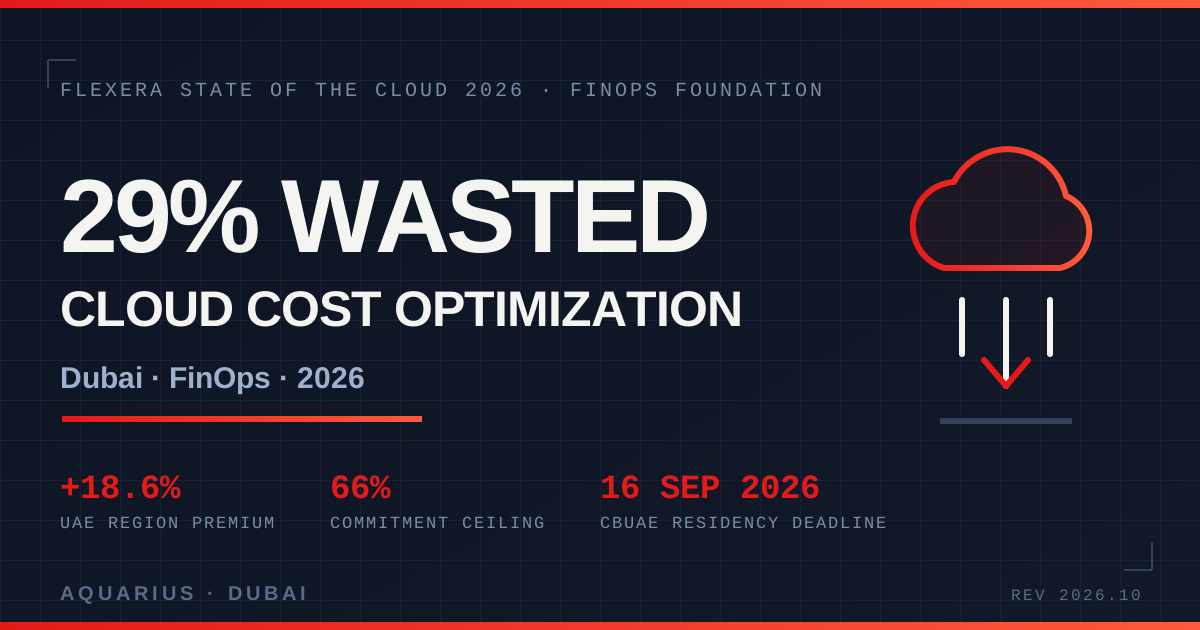
Short answer: Assume roughly 29% of your Dubai cloud bill is waste — that is the 2026 enterprise average, and it is the first increase in five years. On an AED 150,000 a month AWS or Azure estate that is about AED 522,000 a year paying for nothing. A focused eight-week optimisation programme typically recovers 18–30% of run-rate without touching architecture, because UAE accounts carry two penalties most global playbooks ignore: a UAE region premium of roughly 18.6% over US pricing, and data-residency rules that stop you moving the workload somewhere cheaper. Budget AED 6,500–18,000 for a cost audit and AED 25,000–70,000 for an optimisation sprint — which on that estate pays itself back in under two months.
Key takeaways
- Waste is rising, not falling: enterprises waste an average 29% of IaaS and PaaS spend in 2026, up from 27% in 2025. Only 14% of organisations have reached the FinOps maturity level where waste actually declines.
- Dubai pays a location tax: AWS me-central-1 averages about 18.6% above us-east-1, and up to roughly 25% more on x86 instance families. You cannot optimise that away — you can only size around it.
- Commitments are the biggest single lever: AWS Compute Savings Plans reach up to 66% off on-demand and EC2 Instance Savings Plans up to 72%, yet unused commitment discount stays one of the top waste sources.
- Residency now has a date on it: CBUAE Federal Decree-Law No. 6 of 2025 took effect 16 September 2025 with a one-year reconciliation period, so regulated payment data must be localised in the UAE by 16 September 2026.
- AI is the new line item: 98% of FinOps teams now manage AI spend, against 31% two years ago. An H100 running 24/7 in a UAE hyperscaler region costs roughly AED 33,000 a month.
Dubai is buying cloud far faster than it is governing cloud
Three numbers explain why cloud bills in the UAE are growing faster than the businesses underneath them.
- The market is compounding at nearly 28% a year. The UAE cloud computing market is worth about USD 16.43 billion in 2026 and is forecast to reach USD 56.26 billion by 2031 at a 27.93% CAGR. Hyperscalers have committed more than USD 10 billion in fresh regional capacity.
- Regional IT spend is in an infrastructure cycle. Gartner puts MENA IT spending at USD 169 billion in 2026, up 8.9%, with data centre systems the fastest-growing segment at +37.3% to USD 13 billion and software up 13.9% to USD 20.4 billion. Capacity is being bought ahead of demand.
- And the waste rate went the wrong way. Flexera's 2026 State of the Cloud report has enterprises wasting 29% of IaaS and PaaS spend, up from 27% — the first rise in five years. The FinOps Foundation's 2026 survey of 1,192 practitioners managing a combined USD 83 billion of cloud spend found only 14% at the maturity level where waste genuinely shrinks.
Here is what most Dubai businesses get wrong. They treat the cloud bill as a procurement problem — something to negotiate once a year with a reseller — when it is an engineering problem that bills by the hour. Nobody signs off AED 40,000 of waste. It accumulates in AED 900 increments: a staging cluster left running over Eid, an oversized database instance from a 2023 load test, a dev account nobody owns, a NAT gateway quietly charging for cross-AZ chatter. By the time finance notices, the waste is structural.
Where the money actually leaks in a UAE account
Generic cost-cutting advice is written for us-east-1. Two things are different here.
The region premium is real and permanent. AWS me-central-1 (UAE) runs roughly 18.6% above us-east-1 on average across instance types, and comparisons of x86 families put the gap nearer 25%. Azure UAE North and Google Cloud me-central1 price similarly. Every unit of waste in a Dubai-hosted estate therefore costs about a fifth more than the same waste in Virginia — and every rightsizing win is worth about a fifth more too.
Egress is priced against you. Internet data transfer out of US regions starts at USD 0.09 per GB for the first 10 TB, while CloudFront's Middle East edge tier is USD 0.110 per GB, and inter-region transfer adds about USD 0.02 per GB. Architectures that keep a database in Frankfurt and an application in Dubai pay that toll on every query round trip, forever.
In practice, the five leaks we find in almost every Dubai estate:
- Non-production running 24/7. Dev, staging and QA rarely need more than 50 hours a week. Scheduled start/stop is the single fastest win and routinely removes 60–70% of non-prod compute hours.
- Oversizing inherited from a launch-day guess. Instances sized for a traffic forecast that never arrived, never revisited. Idle compute and oversized instances together account for the majority of measured waste.
- No commitment coverage, or the wrong commitment. Paying on-demand for a workload that has run continuously for 18 months is a pure discount giveaway.
- Storage and snapshot sediment. Unattached volumes, years of automated snapshots, logs sitting on hot storage classes, backup copies with no retention policy.
- Unclaimed input VAT. Covered below — and often the easiest five-figure recovery on the list.
The AED maths on a typical Dubai cloud bill
Apply the 29% benchmark to real monthly spend, then apply what is realistically recoverable in year one. The recovery column assumes commitments plus scheduling plus rightsizing only — no re-architecture.
| Monthly cloud spend | Annual spend | Waste at 29% benchmark | Realistic 12-month recovery (18–30%) |
|---|---|---|---|
| AED 15,000 | AED 180,000 | AED 52,200 | AED 32,000–54,000 |
| AED 50,000 | AED 600,000 | AED 174,000 | AED 108,000–180,000 |
| AED 150,000 | AED 1,800,000 | AED 522,000 | AED 324,000–540,000 |
| AED 400,000 | AED 4,800,000 | AED 1,392,000 | AED 864,000–1,440,000 |
The commitment lever is worth understanding precisely, because the headline numbers vendors quote are the best case, not the typical case. On AWS, a 1-year Compute Savings Plan with no upfront payment discounts roughly 27–31%; 3-year all-upfront reaches 62–66%. EC2 Instance Savings Plans go to 72% but lock you to an instance family in one region — a poor trade in a UAE estate that may need to shift families as capacity and residency rules move. Most Dubai SMEs should sit on 1-year flexible commitments covering 60–75% of steady-state compute and leave the remainder on-demand.
The VAT line most Dubai finance teams never claim
Since 1 February 2024, Amazon Web Services EMEA SARL has operated local branches in Dubai and Abu Dhabi. UAE accounts are invoiced locally, charged 5% UAE VAT, and issued a proper tax invoice carrying the supplier and recipient TRN, with the VAT remitted to the Federal Tax Authority.
That matters twice over. First, for a VAT-registered business that VAT is recoverable input tax — but only against a valid invoice, which means your 15-digit TRN must actually be stored on the cloud account. We regularly find accounts opened years ago by a developer with no TRN on file, quietly converting recoverable tax into sunk cost. Second, an invoice from a local branch removes the reverse-charge gymnastics that non-resident supplier invoices create for your accountant.
Check three things this week: the TRN on every cloud account, whether the billing entity matches the UAE legal entity claiming the input tax, and whether anyone has ever reconciled cloud invoices against VAT returns. On an AED 1.8 million annual estate the VAT line alone is AED 90,000.
Residency is the constraint that makes naive cost cutting illegal
The cheapest fix for a Dubai cloud bill is usually "move it to Europe or Virginia". For regulated data, that is not a decision you get to make.
- Payments and financial data. CBUAE Federal Decree-Law No. 6 of 2025 came into effect 16 September 2025 with a one-year reconciliation window for existing licensees, bringing payment-data localisation inside the UAE, five-year retention, and 72-hour incident notification. The reconciliation deadline is 16 September 2026. In February 2026 the Central Bank launched a sovereign financial cloud platform with Core42 under its FIT Programme.
- Health data. Under NABIDH, the DHA's data and health information protection policy, health data generated in Dubai must remain inside the UAE absent explicit approval — reinforced federally by Law No. 2 of 2019 on ICT in healthcare.
- Government and semi-government work. The DESC Cloud Service Provider Security Standard is mandatory for any provider hosting Dubai government or semi-government data, and workloads must be classified under Digital Dubai's Public / Internal / Confidential / Secret scheme before placement.
This is why sovereign capacity is expensive and growing fast: Gartner expects worldwide sovereign cloud IaaS spending to hit USD 80 billion in 2026, up 35.6%. The practical answer is not to fight residency but to tier against it. Classify every dataset once, keep the regulated tier in-region and heavily committed, and push everything genuinely unregulated — CI runners, build caches, analytics on anonymised data, model training on public corpora — to cheaper regions or interruptible capacity. Teams that skip the classification step either overpay for everything or quietly breach something. See our deeper notes on AI data residency in the UAE and on what a UAE cloud migration actually costs.
GPUs are where 2026 bills explode
AI spend went from side quest to standing agenda item: 98% of FinOps teams now manage AI costs, against 31% two years ago. The pricing gap in the Gulf is severe.
| H100 capacity, Gulf region | Per hour | AED per hour | 24/7 for one month |
|---|---|---|---|
| Azure UAE North | ~USD 14.00 | ~AED 51 | ~AED 37,500 |
| Google Cloud me-central1 | ~USD 12.49 | ~AED 46 | ~AED 33,500 |
| AWS me-central-1 | ~USD 12.30 | ~AED 45 | ~AED 33,000 |
| Specialist regional GPU cloud, on-demand | ~USD 5.07 | ~AED 19 | ~AED 13,600 |
| Specialist regional GPU cloud, spot | ~USD 2.91 | ~AED 11 | ~AED 7,800 |
Hyperscaler Gulf-region H100 rates run roughly 2.5x above specialist providers on-demand and 4–5x above spot. Training on anonymised or public data does not usually trigger residency restrictions — so the single highest-value GPU decision for most Dubai teams is to split training from inference: train on cheap interruptible capacity, serve in-region where latency and compliance require it. Leaving a fine-tuning endpoint idle in a hyperscaler UAE region is the most expensive form of forgetfulness available in 2026.
What cloud cost work costs in Dubai, and how we run it
Indicative 2026 Aquarius engagement ranges. Figures exclude VAT.
| Engagement | AED | Timeline | What you get |
|---|---|---|---|
| Cloud cost audit | 6,500–18,000 | 5–10 working days | Line-item waste map, commitment plan, residency flags, prioritised savings list with AED values |
| Optimisation sprint | 25,000–70,000 | 4–8 weeks | Scheduling, rightsizing, storage lifecycle, commitment purchase, tagging and showback, budget alerts |
| Architecture rework | 70,000–180,000 | 8–16 weeks | Re-platforming the expensive parts: egress paths, data tiering, serverless or container consolidation |
| FinOps care retainer | 3,500–12,000 / month | Ongoing | Monthly anomaly review, commitment renewals, unit-cost reporting per product or customer |
How we sequence it: measure before touching anything, tag everything so every dirham has an owner, take the free wins first (scheduling, orphaned storage, TRN and VAT), only then buy commitments, and re-architect last. Every recommendation arrives with an AED number and a residency verdict attached, so finance and compliance sign the same document. If the audit cannot identify savings worth more than its own fee, we tell you in week one instead of selling you a sprint. Our published pricing shows the full range, and the fastest start is a 30-minute review of last month's bill.
FAQ
How much can I realistically save on my Dubai cloud bill?
Benchmark waste is 29% of IaaS and PaaS spend, and a first-year programme that stops at scheduling, rightsizing and commitments typically recovers 18–30% of run-rate. On AED 150,000 a month that is AED 324,000–540,000 over twelve months. Larger numbers are possible but usually require re-architecting egress paths or data tiering.
Is it cheaper to host outside the UAE?
On raw compute, yes — AWS me-central-1 averages about 18.6% above us-east-1, and up to roughly 25% on x86 families. But it is only legal for unregulated data. Payment data falls under CBUAE Federal Decree-Law No. 6 of 2025 with a 16 September 2026 reconciliation deadline, Dubai health data must stay in the UAE under NABIDH, and Dubai government workloads need a DESC-certified provider. Classify the data first, then place it.
Should I buy 1-year or 3-year Savings Plans?
For most Dubai SMEs, 1-year flexible Compute Savings Plans covering 60–75% of steady-state compute. A 1-year no-upfront plan discounts roughly 27–31%; 3-year all-upfront reaches 62–66% but locks capital and architecture for three years in a region where instance availability and residency rules are still moving.
Can I reclaim the VAT on AWS and Azure invoices?
If you are VAT-registered, yes. AWS has invoiced UAE customers through local Dubai and Abu Dhabi branches with 5% UAE VAT since 1 February 2024 and issues a tax invoice with TRNs. The common failure is administrative: no TRN on the cloud account, or a billing entity that does not match the entity claiming the input tax.
Do we need a full-time FinOps hire?
Below roughly AED 200,000 a month in cloud spend, no — a quarterly review plus automated anomaly alerts and a monthly retainer covers it. Above that, unit economics per product or per customer start to matter enough to justify internal ownership. Only 14% of organisations reach the maturity level where waste actually falls, so part-time ownership with external review is usually the honest answer.