
Apple Wallet and Google Wallet Passes for Dubai Businesses (2026): The Loyalty App You Do Not Have to Build
Android holds 73.3% of UAE phone traffic, yet Emirates ID only sits in Apple Wallet and nol only on Samsung. Real pass platform fees, AED build ranges and what ships in two weeks.
- PUBLISHED
- 24 OCT 2026
- READ TIME
- 12 MIN
- AUTHOR
- AQUARIUS · DUBAI
- UNIT
- REV 2026.09
Short answer: a wallet pass is the cheapest customer-retention channel in Dubai right now — a signed file that lands in Apple Wallet or Google Wallet from a QR code, a link or a WhatsApp message, with no app download, no App Store review and no cost per install. A hosted pass programme runs AED 9,000–18,000 to launch and roughly AED 150–950 a month to operate; a custom pass-issuing service with your own certificates, push updates and a points ledger runs AED 28,000–55,000. The one thing it will not do in 2026 is replace a nol card or an Emirates ID — those sit behind national integrations, not developer APIs.
Dubai’s wallet numbers, before you pick a platform
Three figures decide the shape of the build, and most briefs we receive in Dubai get the first one backwards.
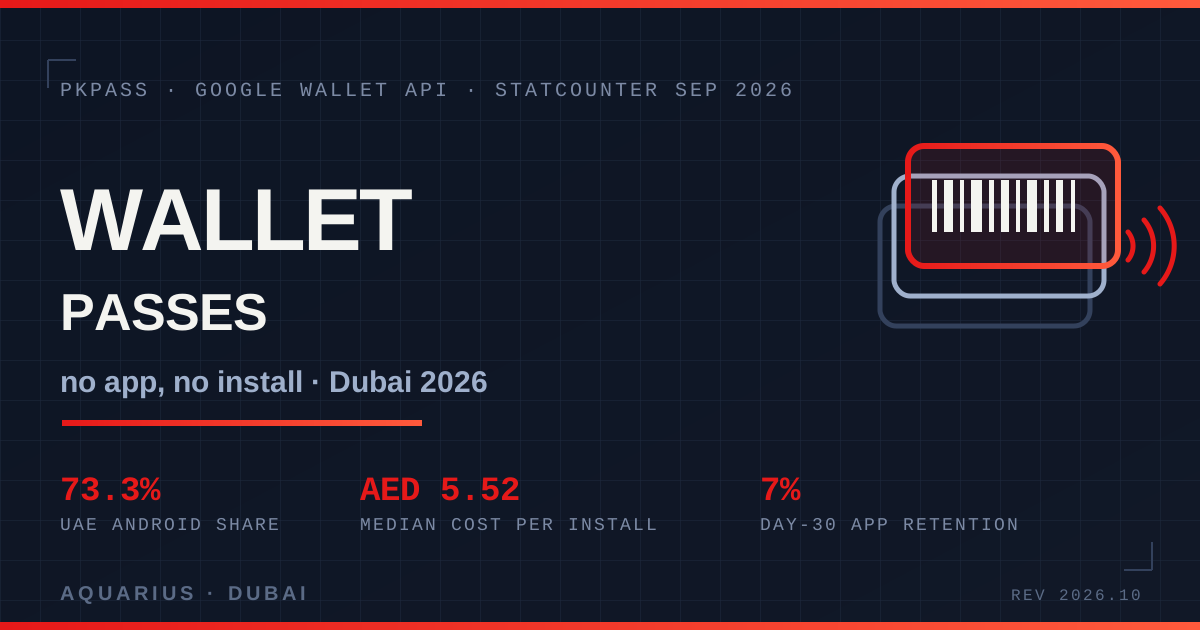
- Android is the majority platform in the UAE. StatCounter’s September 2026 mobile figures for the UAE put Android at 73.3% of mobile web traffic and iOS at 26.68%. Building Apple Wallet only — which is what a surprising number of Dubai retailers do, because the decision-maker carries an iPhone — leaves roughly three in four handsets without a pass.
- The money is in retention, and it is growing. The UAE loyalty market was put at USD 432.3m in 2026, forecast to reach USD 733.8m by 2030 at a 14.1% CAGR in the Q2 2026 UAE Loyalty Databook. The incumbents in that market are not small: Majid Al Futtaim SHARE, Emirates Skywards, ADNOC Distribution and e& Smiles.
- Installs are expensive and they do not stick. UAE cost-per-install benchmarks for 2026 put the median near AED 5.52, with monthly swings from AED 0.74 in December 2025 to AED 23.64 in March 2026, and fintech categories quoted at AED 25–80 per install. Global day-30 retention sits near 7% — 5.3% on iOS, 3.8% on Android. You pay for the install either way; 93 times out of 100 the icon is dead within a month.
A wallet pass inverts that economics. It costs fractions of a fil to issue, it cannot be lost to a storage cleanup because it lives in a system app the customer already has, and it updates silently over the air. Its weakness is that it is not an app: no screens, no logic, no in-pass checkout. Knowing exactly where that line falls is the whole job.
The Dubai wallet asymmetry nobody plans for
Here is the part that catches teams out. Dubai’s two most-carried credentials sit in opposite wallets, and neither is available to you as a developer.
| Dubai / UAE credential | Apple Wallet | Samsung / Huawei | Google Wallet | How it gets there |
|---|---|---|---|---|
| Emirates ID (digital) | Yes | No — QR view only | No | ICP app, signed in with UAE PASS |
| Dubai driving licence | Yes | Samsung: yes | No | RTA app — Dubai-issued licences only |
| Dubai vehicle licence | Yes | Samsung: yes | No | RTA app, Vehicles tab |
| nol card | No | Samsung via nol Pay; Huawei Wallet | No | RTA / nol Pay over NFC |
| Emirates and Etihad boarding passes | Yes | Yes | Yes | Airline app, PassKit / Google Wallet API |
| Cinema tickets (e.g. VOX) | Yes | Yes | Yes | Standard event-ticket pass |
| Your loyalty card, coupon, membership or ticket | Yes | Yes | Yes | You issue it — this article |
So the Emirates ID is Apple-only, and the nol card is Samsung-and-Huawei-only. If your onboarding copy says “add your card to Apple Wallet”, a Samsung-carrying customer in Deira reads that as “this is not for me” — and that is 73% of the market. Write platform-neutral copy and ship both pass formats from day one. For identity itself you integrate UAE PASS, not a wallet.
The myth to kill: “we need an app so customers can carry their card.” You need a pass. The app is the version of that idea that costs AED 5.52 per install and is gone by day 30.
What you can actually issue in 2026
Apple Wallet
An Apple pass is a .pkpass bundle — a pass.json, images, and a signature from a Pass Type ID certificate issued under your Apple Developer Program membership (USD 99 a year, about AED 364; UAE organisation enrolment needs your trade licence and a D-U-N-S number). The classic styles are boarding pass, coupon, event ticket, store card and generic.
WWDC 2026 added real capability to that list:
- Poster Generic — a full-artwork pass style for memberships and store cards, with a background image, logo, header fields, primary fields, a single footer field and an optional barcode. It requires iOS 27 or later, so you ship the
posterGenericand legacygenerickeys side by side to keep iOS 26 users working. - Four new barcode formats — EAN-13, Code 39, Codabar and ITF, which finally match scanners already installed across UAE retail and clinics. List them in priority order with a QR fallback for iOS 26, and surface the credential ID as a text field so a cashier can key it in manually.
- Featured Actions — up to two labelled buttons under the pass, on every pass style, each with an identifier, a type and a URL. This is where “Top up”, “Book a table” or “View benefits” goes.
- Pass Designer and Pass Builder — a WYSIWYG Mac app producing
.pkpasstemplatefiles, plus a Swift-on-server package with abuildpasscommand-line tool for signing at scale. Designers can own the artwork without a developer in the loop.
Google Wallet
Google’s side is a REST API plus a signed JWT behind the Add to Google Wallet button, with first-class classes for loyalty, offers, gift cards, event tickets, transit, boarding passes and a catch-all generic pass. Two operational details matter: calls are rate limited to 20 requests per second, so plan bulk issuance around that, and a new issuer account starts in demo mode — passes work only for allow-listed testers until Google grants publishing access. Generic private passes, the ones carrying sensitive data, need explicit permission and verification documents from Google.
NFC taps are a different project
Barcode passes are self-service. Tap-to-enter passes are not: Apple requires a separate NFC certificate and entitlement, granted only after a review of your specific use case and backend, and that review is quoted at four weeks minimum — on top of needing verified NFC readers at the door. If your gym, clinic or venue wants tap-in membership, budget the approval window into the project plan, not into launch week. If what you actually need is card-present payment on a phone, that is a different stack — see our Tap to Pay on iPhone guide for the UAE.
Real costs: platform fees in AED
Pass issuance is one of the rare channels where the platform cost is close to zero and nearly all your spend is the build. Converted at AED 3.6725 to the dollar:
| Line item | Published price | In AED | Notes |
|---|---|---|---|
| Apple Developer Program | USD 99 / year | ~AED 364 / year | Mandatory for Pass Type ID certificates |
| Google Wallet API | No published per-pass fee | — | Issuer account, 20 req/s, demo mode until approved |
| PassKit platform fee | USD 39.50–249.50 / month | ~AED 145–916 / month | Priced by team seats; 250 passes included; supports NFC |
| PassKit per pass, multi-use | USD 0.045 at the 251–2,500 tier | ~16 fils each | Falls to USD 0.0005 above 5m passes |
| PassKit per pass, single-use | USD 0.0945 at the 251–2,500 tier | ~35 fils each | Tickets and coupons, billed on issue |
| WalletWallet API | Free to 1,000 ops/month, then USD 39 for 100k ops, USD 99 business | ~AED 143–364 / month | Billed per API operation; no NFC support |
Run the arithmetic for a mid-sized Dubai F&B group: 10,000 loyalty cards updated twice a month on a per-pass platform lands near AED 650–800 a month, all in. The same 10,000 customers acquired as app installs at the UAE median CPI of AED 5.52 costs AED 55,200 once — and leaves you roughly 700 of them still opening the app on day 30.
What it costs to build in Dubai
These are the ranges we quote in Dubai for pass work, inclusive of design, Arabic and English localisation and go-live support. Full breakdowns sit on our pricing page.
| Scope | What you get | Timeline | AED |
|---|---|---|---|
| Hosted pass programme | Vendor platform, branded Apple and Google passes, enrolment landing page, QR and WhatsApp distribution, CRM webhook | 1.5–2 weeks | 9,000 – 18,000 |
| Custom issuing service | Your own certificates, pass.json and JWT generation, APNs update service, points or balance ledger, bilingual fields, admin console | 4–6 weeks | 28,000 – 55,000 |
| NFC entry or membership tap | Apple NFC entitlement application, verified reader integration, turnstile or door controller, offline fallback | 8–12 weeks, plus 4+ weeks Apple review | 65,000 – 140,000 |
| Pass layer on an existing app | Add to Wallet inside your current iOS and Android app, deep links, pass-state sync | 2–3 weeks | 14,000 – 26,000 |
If you are weighing this against a full loyalty product, read the cost comparison in our Dubai loyalty and rewards app guide; for venues, the event ticketing platform breakdown covers the ticket-side economics.
Why 2026 is the year to ship it in Dubai
Dubai is rebuilding its payment rails underneath you. RTA’s nol upgrade is an AED 550m programme, reported at 72% complete and targeted for the end of Q3 2026, that moves nol from card-based to account-based ticketing with digital wallets, QR payments, linked family cards and automatic top-up. The scale it runs at: more than 1.5 million nol transactions a day, and 348 million riders across Dubai public transport, shared mobility and taxis in the first half of 2026 alone. Dubai’s Cashless Strategy, launched in October 2024, targets 90% of transactions cashless and projects more than AED 8bn a year in GDP impact.
Customers whose transit card, driving licence and Emirates ID already live in a phone wallet stop treating “add to wallet” as a novelty. That habit is free distribution being handed to you. Businesses with a pass ready when the habit completes will collect it; the ones still scoping an app will pay AED 5.52 a head to chase the same people.
How Aquarius builds pass programmes
We start with the scanner and the till, not the design. Which barcode format does your existing POS read, who scans it, and does the cashier have a manual-entry fallback at 9pm on a Thursday in Dubai Mall? Then we map fields twice — English and Arabic, with correct right-to-left layout — because a half-localised pass gets deleted. We keep pass payloads minimal by default: a member ID and a balance, never a passport or Emirates ID number, which keeps you clean under Federal Decree-Law 45/2021 (PDPL), whose Executive Regulations and fine schedule were still unpublished as of October 2026. And we hand over the signing certificates, the renewal calendar and the update service — they are yours, not locked inside our account.
Fixed scope, fixed price, and a working pass on a real iPhone and a real Samsung before you approve the invoice. If the pass does not install and update on both platforms, you do not pay for that milestone.
Tell us what your customers carry today and we will come back with the pass format, the platform cost and the AED number — usually within two working days.
FAQ
Can I add a nol card to Apple Wallet in 2026?
No. As of October 2026, digital nol lives on Samsung — through the nol Pay app — and on Huawei Wallet. iPhone users get the nol Pay app, which reads the card over NFC and accepts Apple Pay for top-ups from AED 5, but not a tappable pass inside Apple Wallet. RTA’s AED 550m account-based ticketing upgrade is the route to that changing; some reporting points to early 2027 for the full consumer rollout, and RTA has not published a confirmed Apple Wallet date.
Do I need a mobile app to issue wallet passes?
No, and that is the main reason to do it. A pass is a signed file for Apple and a signed JWT link for Google. You can deliver it from a web page, an email, a WhatsApp message, a printed QR code at the till, or an SMS. An app only becomes necessary when you need screens and logic a pass cannot hold — ordering, receipt scanning, in-app payment.
Is the Google Wallet API free?
Google publishes no per-pass fee for the Wallet API, so your real costs are the build and your own hosting. Two constraints to design around: 20 requests per second, and a new issuer account that stays in demo mode — usable only by allow-listed testers — until Google grants publishing access. Passes carrying sensitive data need separate approval and verification documents.
Does PDPL apply to a loyalty pass?
Yes — a pass holding a name, a member ID and purchase history is personal data under Federal Decree-Law 45/2021. The practical control is data minimisation: keep identity numbers out of the pass payload, state the retention period at enrolment, and make opt-out as easy as the Add to Wallet button was. Note that the PDPL’s Executive Regulations and penalty schedule were still unpublished as of October 2026, so what you are judged against today is your own privacy notice plus consumer-protection law.
Can a wallet pass fully replace a loyalty app?
For stamp cards, tiers, coupons, memberships, tickets and gift balances — yes, and better, because there is nothing to install. You give up three things: interactive screens, rich push messaging (a pass update is a field change plus a short notification, not a campaign), and any flow that needs the customer to type. The pattern that works in Dubai is to launch the pass first, measure redemption for a quarter, and build the app only if the data proves you need those three things.