
Agency Management Software in Dubai (2026): Utilisation, Retainers and the 31 December Tax Cliff
Agencies average 66.4% billable utilisation and only 1% bill all their out-of-scope work. What agency management software costs in Dubai, and the 2026-27 tax and e-invoicing dates that change the spec.
- PUBLISHED
- 03 OCT 2026
- READ TIME
- 12 MIN
- AUTHOR
- AQUARIUS · DUBAI
- UNIT
- REV 2026.09
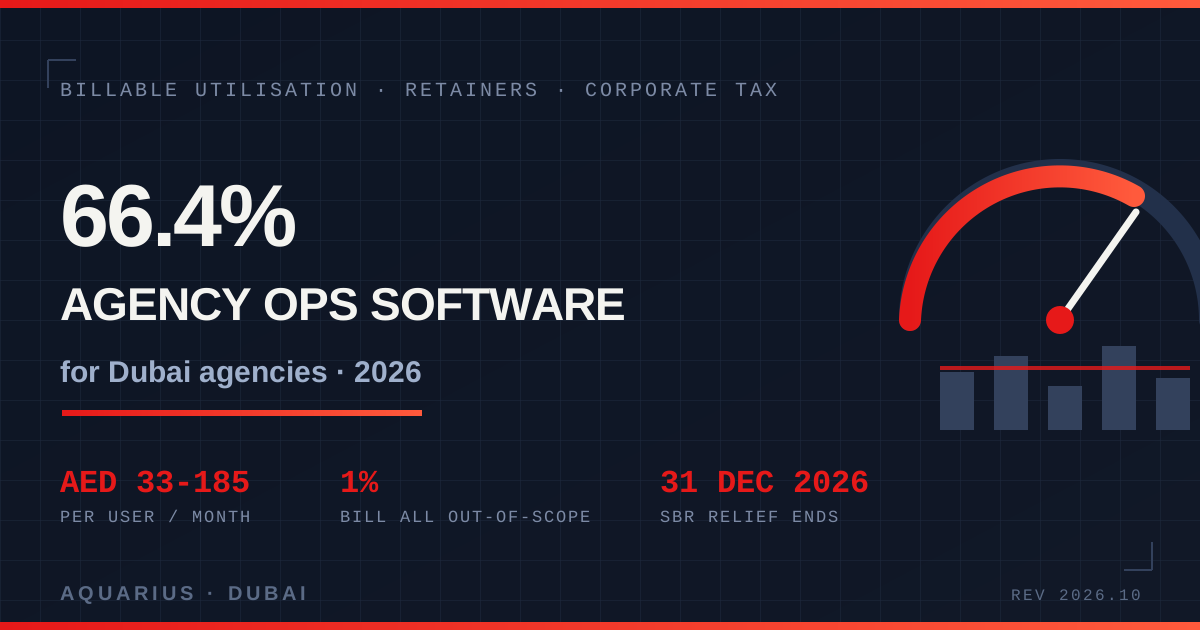
Short answer: agency management software in Dubai costs roughly AED 33-185 per user per month off the shelf - about AED 400-1,850 a month for a ten-person agency - or AED 90,000-400,000 for a custom build. Dubai agencies are buying it in 2026 for one reason: average billable utilisation has fallen to 66.4%, only 1% of agencies bill all their out-of-scope work, and from 1 January 2027 every UAE agency sits inside the 9% corporate tax regime with e-invoicing attached.
Key takeaways
- Utilisation is at a record low. The 2026 Professional Services Maturity Benchmark puts average billable utilisation at 66.4% for 2025, against 75.0% for high performers. Firms below 60% average net margins of 8-12%; above 70% they hit 18-22%.
- Scope creep is measurable. 52% of projects experience it and 85% of those exceed budget by an average of 27%. In creative and software work the creep rate runs 60-70%.
- Most agencies eat it. In a 2025 survey of 273 agency managers and executives, 57% lost USD 1,000-5,000 a month on unbilled work and 30% lost more than USD 5,000. Only 1% bill all of it.
- Small Business Relief ends with the 2026 tax period. The AED 3 million revenue election only covers tax periods ending on or before 31 December 2026. After that it is 0% to AED 375,000 and 9% above, for everyone.
- Two more dates belong in the spec. E-invoicing goes live for AED 50m-plus businesses on 1 January 2027 and the rest on 1 July 2027. The Advertiser Permit has been enforced since 1 February 2026, with fines to AED 1,000,000.
The Dubai agency market in three numbers
Dubai is not short of demand. It is short of agencies that can prove which part of it is profitable.
- UAE digital ad spend is forecast at USD 2.64 billion in 2026, growing 15.2% year on year and projected to reach USD 4.30 billion by 2029. Dubai alone has passed USD 1.2 billion.
- The client base keeps multiplying. Dubai Chamber of Commerce registered 34,800 new member companies in the first six months of 2026. Every one is a potential brief - and a potential unprofitable retainer.
- Capacity, not pipeline, is the constraint. At 66.4% utilisation, a ten-person agency pays for roughly 1,680 hours a month of salaried capacity and invoices against about 1,115. That gap is the whole argument for instrumenting the business.
Most Dubai agency owners get this wrong: they think the margin problem is a rate problem. It is a measurement problem. You cannot defend a rate when your cost per billable hour is a guess.
Where the margin actually leaks
Three leaks account for most of it, all invisible without a system of record.
1. Unbilled scope
Convert that survey finding to local money. USD 1,000-5,000 a month of unbilled work is AED 3,670-18,360 a month at the pegged rate of AED 3.6725 - AED 44,000-220,000 a year. The 30% of agencies above USD 5,000 a month lose more than AED 220,000 a year: a senior hire, funded entirely by work you already did.
2. The utilisation band you did not choose
Creative and marketing teams are expected to run above the professional-services average because billing rates are lower - roughly 75-85% for pure producers such as designers, developers and writers, with agencies of one to ten people benchmarked at 70-85%, eleven to fifty at 60-75% and fifty-plus at 65-70%. The sustainable target is 70-75%: high enough for peak profit, low enough that the team is still there in a year.
3. Cost per billable hour, never calculated
Do the Dubai arithmetic once. A digital marketing manager here earns roughly AED 15,000-25,000 a month (specialists AED 8,000-15,000; senior managers AED 25,000-35,000). Take AED 20,000, add about 30% for visa, insurance, gratuity accrual, desk and software: loaded cost around AED 26,000. Across roughly 168 working hours that is AED 155 per paid hour - but at 66.4% utilisation a billable hour truly costs about AED 233. At 75% it falls to about AED 206. That one number tells you whether an AED 8,000 retainer is a win or a slow loss.
What agency management software has to do in Dubai
Ignore feature lists. Six jobs matter, and a tool that fails any of them gets abandoned inside two quarters.
- Time capture people actually complete. Timesheets filled on Friday afternoon are fiction. Daily, assignment-based capture with timers is the only version that produces usable utilisation data.
- Retainer burn-down in real time. A visible consumed-versus-committed figure per client, so the conversation happens at 70% of scope rather than 130%.
- Profitability per client, project and service line. Revenue minus loaded cost, not revenue minus invoices. This is the number that survives the move into the 9% tax regime.
- Change orders as a one-click object. If logging out-of-scope work is harder than absorbing it, it gets absorbed. That is how 99% of agencies end up unable to bill it.
- VAT-correct, bilingual, e-invoicing-ready billing. 5% VAT, AED invoices, your TRN, Arabic-capable output, and an export path to an FTA-accredited service provider.
- Capacity planning by skill, not headcount. Ramadan, the summer slowdown, GITEX and the Q4 retail rush are the real Dubai calendar. Forecast against it or hire against the wrong month.
What it costs in 2026
Published list pricing, converted at AED 3.6725 and excluding 5% VAT. Most vendors bill in USD, so the AED figure moves only with the peg.
| Route | What you get | Cost per user / month | Fit |
|---|---|---|---|
| General work OS (Monday.com) | Boards, tasks, light time tracking, dashboards | USD 9-19 (AED 33-70) | Under 10 people, project work |
| Delivery-led (Teamwork) | Projects plus billing, retainers, client users | USD 10.99-19.99 (AED 40-73) | 10-30 people, retainer mix |
| Agency ops (Productive) | Time, budgets, profitability, resourcing, invoicing | USD 11-39 (AED 40-143) | The default for most Dubai agencies |
| Full suite (Scoro) | Quote-to-cash, utilisation, forecasting; 5-user minimum | USD 28-42 (AED 103-154) | 20-80 people, complex rate cards |
| Enterprise agency (Workamajig) | Traffic, finance, media accounting; 5-user minimum | From USD 50 (AED 184) | Large creative and media shops |
| Custom build (Aquarius band) | Bespoke ops platform, your rate logic, your integrations, your data | AED 90,000-400,000 one-off | Unusual commercial model or multi-entity groups |
For a ten-person agency that is roughly AED 400 a month at the entry tier, AED 1,030 mid-plan and about AED 1,850 on an enterprise suite - against a single unbilled change order of AED 4,000. Budget separately for implementation: data migration, rate-card setup and training runs AED 15,000-60,000, and agencies that skip it are the ones whose dashboards are wrong six months later.
Dubai retainers: what the system has to be able to price
Whatever you choose has to model how Dubai actually buys. Current retainers for social and digital work cluster at AED 3,000-8,000 a month for a freelancer or boutique on one or two platforms, AED 8,000-20,000 for a mid-size retainer with content, ads and reporting, and AED 20,000+ for full-service management. By agency size: boutique AED 8,000-15,000, mid-sized AED 15,000-35,000, large full-service AED 35,000-75,000+. Paid media is usually separate at 15-25% of ad spend with a minimum fee of AED 2,500-5,000 a month.
Read that against the AED 233 cost-per-billable-hour figure above. An AED 8,000 retainer buys about 34 genuinely billable hours at cost - before any margin. If the scope quietly implies 50, the account loses money every month it renews. Percentage-of-spend accounts have the opposite problem: the fee is capped by the client budget while the work scales with channel count. You need both models side by side on the same cost basis, or you keep cross-subsidising the loud accounts with the quiet ones.
The 2026-27 compliance calendar that changes the spec
Four dates with system consequences, three of them inside the next fifteen months.
- 31 December 2026 - Small Business Relief ends. The election that treats a resident business with revenue of AED 3 million or less as having no taxable income is only available for tax periods ending on or before that date. From 1 January 2027 the standard regime applies to everyone: 0% up to AED 375,000 and 9% above it. Agencies that have never tracked cost by project will be computing taxable profit from a spreadsheet that was never built for it.
- 1 July 2026 - e-invoicing opened for pilot and voluntary adoption. Businesses with revenue of AED 50 million or more appoint an Accredited Service Provider by 30 October 2026 and go live 1 January 2027; everyone else appoints by 31 March 2027 and goes live 1 July 2027, with government entities on 1 October 2027. B2B and B2G are in scope, B2C currently is not. Translation: your invoicing has to emit structured data, not a PDF - see UAE e-invoicing ERP integration for the plumbing.
- 1 February 2026 - the Advertiser Permit is being enforced. Under Federal Decree-Law No. 55 of 2023, anyone publishing promotional content in the UAE needs a permit, regardless of platform, follower count or nationality, and whether or not money changed hands - gifted product counts. Fines run from AED 10,000 to AED 1,000,000 under Cabinet Resolution No. 42 of 2025, with content removal and account suspension available too. Permit status is now a field in your campaign record, not a conversation.
- Related-party reporting. A transfer pricing disclosure is due with the annual return above AED 40 million of aggregate related-party transactions or AED 4 million in any single category, plus a connected-persons schedule above AED 500,000 of payments to connected persons. For owner-managed agencies that last threshold bites first - director remuneration reaches it quickly.
Buy, configure or build
Buy if you are under roughly 25 people with a conventional retainer-and-project mix. Productive or Teamwork configured properly in two weeks beats anything bespoke on time-to-value, and you can leave later.
Configure deeply at 25-80 people with real rate-card complexity: multi-currency clients, media commissions, free-zone and mainland entities under one roof. The platform exists; the work is modelling cost rates, approval chains and VAT treatment correctly.
Build when your commercial model is not retainers or time and materials (performance fees, revenue share, licensed assets), when several legal entities need consolidated profitability with per-entity tax reporting, or when delivery itself is the product. Most Dubai groups land on a hybrid - keep the accounting package, build the layer that prices, schedules and reports. Our services page covers that scoping, and workflow automation often removes half the perceived need for a custom build.
What we do differently at Aquarius
We build the commercial half properly, because that is the half that decides whether the agency makes money: loaded cost rates per person instead of one blended rate; retainer burn-down visible to account managers before the overrun; one-click change orders that carry a price; profitability by client, project and service line on the same cost basis; VAT-correct invoicing already shaped for the e-invoicing handover; bilingual Arabic and English output with RTL handled properly. Indicative bands are on pricing.
Risk reversal is simple: we instrument your existing numbers first and show you current utilisation and per-client margin before anyone commits to a build. If a configured off-the-shelf tool solves it, we will say so and help you set it up.
FAQ
How much does agency management software cost in Dubai?
About AED 33-185 per user per month depending on tier - roughly AED 400-1,850 a month for a ten-person agency, excluding 5% VAT - plus AED 15,000-60,000 one-off for migration, rate-card setup and training. A custom platform sits in the AED 90,000-400,000 band.
What billable utilisation should a Dubai agency target?
Sustained 70-75% overall, with pure producers - designers, developers, writers - in the 75-85% band. The 2025 professional-services average was 66.4%; high performers hit 75.0%. Below 60%, net margins fall to 8-12%; above 70% they reach 18-22%.
Does a Dubai agency need to be e-invoicing ready in 2026?
Readiness yes; live operation depends on size. AED 50 million-plus businesses appoint an Accredited Service Provider by 30 October 2026 and go live 1 January 2027; smaller businesses appoint by 31 March 2027 and go live 1 July 2027. Pilot adoption opened 1 July 2026, so make your billing data structured now.
Will my agency pay corporate tax after Small Business Relief ends?
If taxable income exceeds AED 375,000, yes - 9% on the excess, for tax periods beginning on or after 1 January 2027. The AED 3 million relief election only covers periods ending on or before 31 December 2026, so 2026 is the last year it applies.
Does the Advertiser Permit apply to the agency or to the influencer?
To whoever publishes the content - in practice the influencer or brand account - but the agency that commissioned it carries the commercial risk if the permit is missing. Enforcement has run since 1 February 2026 regardless of platform, follower count or whether payment was made, with fines from AED 10,000 to AED 1,000,000.
Where to start
Measure before you buy. Pull one month of real hours against one month of real invoices, work out loaded cost per billable hour, and rank clients by margin instead of revenue. In most Dubai agencies that exercise finds a bottom-quartile client consuming top-quartile capacity - and it costs less than the software. Send us your headcount and retainer mix and we will come back with the utilisation maths and a buy-or-build call, whichever is actually cheaper for you.