
Ad Fraud in Dubai (2026): 20% of UAE Ad Traffic Is Invalid, and What Verification Costs in AED
Fraudlogix puts UAE invalid traffic at 20.10% in Q1 2026 - 2.5x Saudi Arabia. What bots cost Dubai advertisers every month, and what blocking them costs in AED.
- PUBLISHED
- 22 OCT 2026
- READ TIME
- 12 MIN
- AUTHOR
- AQUARIUS · DUBAI
- UNIT
- REV 2026.09
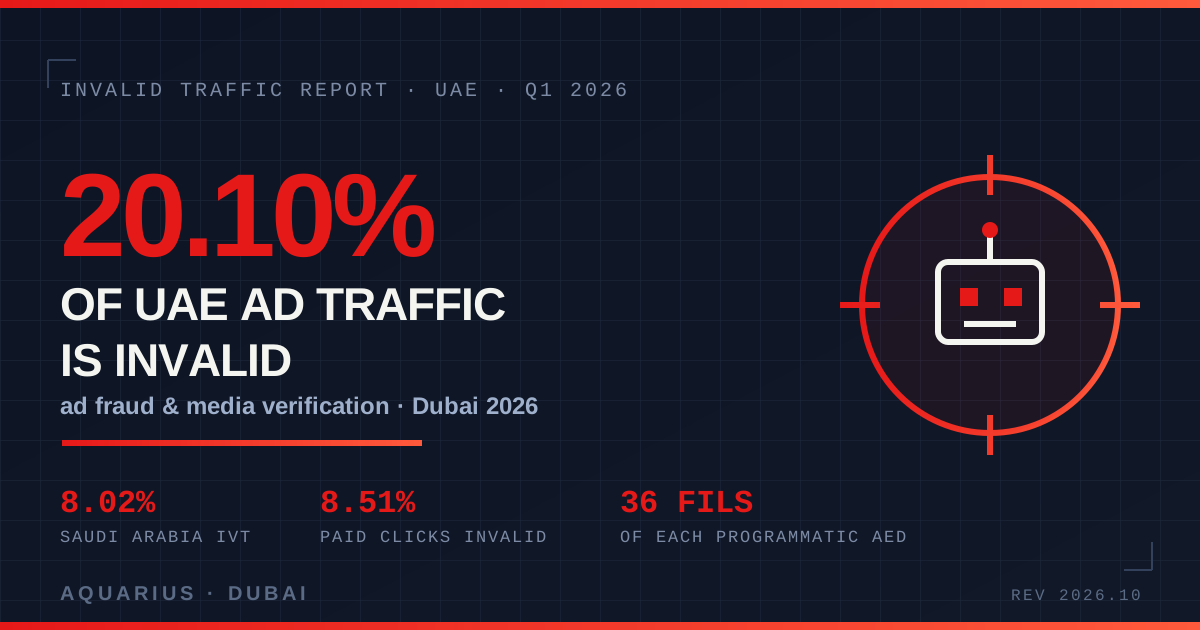
Roughly one in five ad impressions served in the UAE is invalid. Fraudlogix measured UAE invalid traffic (IVT) at 20.28% across 2025 and 20.10% in Q1 2026 — against 8.02% in Saudi Arabia and 7.80% across Europe. On a UAE digital ad market forecast at US$2.64 billion in 2026 (about AED 9.7 billion), that is roughly AED 1.9 billion a year of Dubai and UAE ad spend aimed at something that is not a customer. Most of it is recoverable, and the tooling costs less than a single week of media.
The UAE has a traffic-quality problem its neighbours do not
Ad fraud statistics are usually quoted globally, which hides the thing that matters: fraud is intensely local. Fraudlogix analysed 105.7 billion impressions in 2025 and 26.3 billion more in Q1 2026 across 246 countries. The country splits are not close.
- UAE: 20.28% IVT in 2025, 20.10% in Q1 2026. Essentially flat while the world improved.
- Saudi Arabia: 8.02%. The same region, a quarter of the problem.
- Europe: 7.80%. Global average: 20.64% in 2025, falling to 18.12% in Q1 2026.
- The wider MENA rate sits near 13.78% — so the UAE is dragging its own region’s average upward.
Read that sequence again. The global IVT rate dropped by about two and a half points between 2025 and Q1 2026. The UAE moved by 0.18 of a point. Whatever the industry did to clean itself up, it did not happen here.
Two structural reasons explain most of it. First, the UAE is an expensive market to advertise in — it carries one of the highest average cost-per-click rates in the world, roughly 8% above the US and 20–40% above global averages, with Dubai CPCs commonly landing between AED 2 and AED 45. High payouts attract fraud the way high margins attract counterfeits. Second, a large share of UAE traffic is transient, VPN-heavy and multi-device, which is exactly the signature that detection systems key on — and exactly what fraudsters hide inside.
Most Dubai businesses treat ad fraud as a big-brand problem. It is a small-budget problem: at AED 30,000 a month, one in five wasted impressions is the difference between a campaign that pays back and one that does not.
Where the money actually goes before it reaches a human
Invalid traffic is only the visible half. The Association of National Advertisers’ programmatic transparency work found that of every dollar put into open programmatic, only about 36 cents effectively reaches the end consumer. Roughly 29% disappears into ad-tech transaction costs across the DSP, SSP and exchange chain, and about 35% lands in unmeasurable or low-value environments. The ANA put the recoverable waste at around US$22 billion of an US$88 billion open-web market.
The mechanism is boring and almost universal: the average programmatic campaign runs across roughly 44,000 websites, while the ANA’s own guidance is that a well-run campaign needs 75 to 100 trusted sellers. Nobody chose 44,000 domains. An open exchange chose them, and nobody looked at the list.
Inside that long tail sit made-for-advertising (MFA) sites — pages built to carry ads rather than readers. MFA share of measured spend fell to a record low of 0.39% after a multi-year industry crackdown, but it rose from 0.6% in Q4 2025 to 1.1% in Q1 2026, the first increase since 2023, largely attributed to AI-generated content farms. The floor is not permanent.
Which channels leak most: real 2026 invalid-traffic rates
Lunio’s 2026 Global Invalid Traffic Report analysed 2.7 billion paid ad clicks across six networks and found 8.51% of all paid traffic is invalid — close to one click in twelve — representing more than US$63 billion of wasted global spend per year. The platform spread is where the budget decisions live.
| Platform | Invalid traffic rate | Waste on AED 30,000/month |
|---|---|---|
| TikTok Ads | 24.20% | ≈ AED 7,260 / month |
| LinkedIn Ads | 19.88% | ≈ AED 5,964 / month |
| X (Twitter) Ads | 12.79% | ≈ AED 3,837 / month |
| Microsoft / Bing Ads | 10.32% | ≈ AED 3,096 / month |
| Meta Ads | 8.20% | ≈ AED 2,460 / month |
| Google Ads | 7.57% | ≈ AED 2,271 / month |
Those percentages are not a reason to abandon a channel — TikTok still delivers the cheapest reach in Dubai and LinkedIn still reaches decision-makers nothing else can. They are a reason to price each channel on net delivered traffic rather than gross. A channel with a 24% IVT rate and a 20% lower CPM is not cheaper.
Device and environment matter just as much. In the 2025 Fraudlogix dataset, desktop ran 27.03% IVT against mobile at 19.30% and tablet at 16.34%. By operating system the spread was brutal: Linux 41.78%, Windows 30.55%, Android 20.25%, iOS 16.15%, macOS 12.97%. And traffic originating from cloud infrastructure was almost entirely synthetic — AWS-originated impressions measured 79.24% IVT, with some CDN-origin traffic approaching 100%. A datacentre is not a customer. Excluding datacentre ASNs is a free setting in most platforms and almost nobody in Dubai switches it on.
The new leak nobody budgeted for: AI-driven search campaigns
This is the finding that should change a 2026 media plan. Lunio reviewed 414 million retail ad clicks across 88 accounts from Q4 2025 to Q2 2026 and found Google’s AI Max campaigns carried an invalid traffic rate 72% higher than standard Search. Worse, the trend diverged: AI Max IVT climbed 114% over nine months while standard Search IVT fell 17%. By Q2 2026 AI Max accounted for 55% of retail Search clicks but 68% of invalid Search clicks.
Across Google campaign types in that dataset: Shopping 6.33%, Display 6.05%, Search 4.73%, Performance Max 4.43%. The counter-intuitive part — PMax, the format advertisers distrust most, was the cleanest measured channel, while the newest AI-expanded matching was the dirtiest. Broad AI matching buys you reach by buying you queries nobody vetted.
Relying on the platform to catch it is a partial strategy at best. Google filters most invalid clicks before billing and issues the rest back as “Invalid activity” credits in your billing adjustments — but independent testing suggests its filters still miss a meaningful share, on the order of 7.5% of invalid clicks. Credits are also issued at Google’s discretion, after the fact, with no obligation to show working. If you have never added the Invalid clicks and Invalid click rate columns to your Google Ads reports, you have never seen your own number. That takes thirty seconds and is the single highest-value thing in this article.
One thing genuinely improving: UAE mobile install fraud
AppsFlyer’s State of Fraud for Marketers 2026 gives the UAE a rare piece of good news. Fraudulent app installs in the UAE fell 46% year on year on iOS (9.6 million down to 5.2 million) and 23% on Android (16.7 million down to 12.8 million) through Q1 2026. The dominant UAE technique — fabricated app-store receipts — collapsed from 71% of peak UAE iOS fraud volume in Q2 2025 to 41% by Q1 2026.
The catch is displacement, not defeat. Globally, fraudsters have migrated to less-monitored surfaces: organic traffic now carries 52% of fraudulent installs, and fraud attributed to owned media rose 221% year on year. If you run app install campaigns in Dubai, the fraud has not left your funnel. It has moved to the channel you were not auditing because it looked free.
What verification and blocking actually cost in Dubai (2026, AED)
Enterprise verification is cheaper per impression than advertisers assume and harder to buy than they expect. DoubleVerify disclosed an average fee of about US$0.07 per 1,000 measured transactions in 2025, down 3% year on year; full fraud, viewability and brand-safety coverage is typically quoted at US$0.05–0.10 CPM. IAS sits comparably at roughly US$0.06–0.10 CPM, with its measurement CPMs falling 7% in 2024 and 9% through the first nine months of 2025. Neither publishes a rate card, and both attach annual minimums that put them out of reach of a typical Dubai SME.
Run the arithmetic for a Dubai advertiser spending AED 30,000 a month at an AED 25 CPM: that is 1.2 million impressions, so enterprise verification would cost roughly AED 310 a month in fees — against roughly AED 2,500 a month of invalid traffic at the 8.51% paid-click rate. The economics are not the obstacle. The minimum commitment is. Below roughly AED 150,000 a month in media, SME-tier click-fraud tools plus a properly configured account do the same job.
| Workstream | 2026 range (AED) | Notes |
|---|---|---|
| Traffic-quality audit, single ad account | 4,500 – 12,000 | 3–5 days; invalid-click history, placements, geo and device anomalies |
| Full multi-channel audit (Google, Meta, TikTok, LinkedIn) | 14,000 – 35,000 | 1–2 weeks; cross-channel overlap and duplicate-conversion review |
| Exclusion-list build and placement pruning | 6,000 – 18,000 | Datacentre ASNs, MFA domains, app bundle blocklists, geo fencing |
| Click-fraud blocking tool setup (SME tier) | 5,000 – 15,000 setup | Plus roughly AED 300 – 1,800 / month licence by click volume |
| Server-side tagging and bot filtering | 18,000 – 55,000 | See our server-side tracking guide for the infrastructure half |
| Enterprise verification integration (IAS / DV / HUMAN) | 20,000 – 60,000 setup | Plus vendor CPM fees and an annual minimum; for AED 150k+ / month spend |
| Conversion-validity and lead-quality scoring | 25,000 – 80,000 | Form-fill bot detection, CRM write-back, junk-lead suppression |
| Ongoing traffic-quality monitoring and reporting | From ~2,800 / month | Monthly IVT report, refund claims, exclusion-list maintenance |
Prices exclude 5% VAT and the media itself. Most Dubai accounts recover the audit fee within the first two months purely from suppressed waste — which is the only reason this work gets approved.
The arithmetic for a typical Dubai advertiser
A Dubai SME running AED 30,000 a month across Google and Meta — a mid-range budget given most local campaigns need AED 3,000–5,000 a month just to gather enough data to optimise — loses roughly AED 2,500 a month to invalid clicks at the 8.51% blended rate. That is AED 30,000 a year, or one entire month of media.
The cost of inaction is larger than the waste itself, because wasted spend also costs you the conversions it displaced. Lunio modelled this for a retailer at US$5 million annual spend: roughly US$250,000 of direct wasted spend and about US$750,000 of lost revenue opportunity at 3:1 ROAS. Apply the same 3:1 logic to the Dubai SME above and the real annual cost is closer to AED 120,000 — AED 30,000 burnt plus AED 90,000 of revenue that never happened.
There is a measurement consequence too. Invalid traffic does not just drain budget; it poisons the optimisation signal. Smart-bidding algorithms learn from the clicks they are given. Feed a campaign 20% bot traffic and it will cheerfully bid harder for more of it. That is why fixing traffic quality usually shows up as a conversion-rate improvement before it shows up as a cost saving.
How Aquarius handles traffic quality
We start by reading your own numbers back to you, because almost every Dubai account already contains the evidence. Invalid-click history, placement reports, geo and device splits, conversion-lag distributions, form-fill patterns — the anomalies are usually visible in the first hour, and they are usually concentrated in two or three placements nobody has opened since launch.
Then the cheap fixes: datacentre and cloud ASN exclusions, app bundle and MFA domain blocklists, IP and geo rules tuned for a market with legitimately heavy VPN use, invalid-click columns added to every reporting view, and AI-expanded match types ring-fenced and measured separately rather than trusted by default. After that, the structural work — server-side tagging so bot filtering happens before the data hits your analytics, lead-quality scoring written back to the CRM, and a monthly traffic-quality report that states what was blocked and what was claimed back. Where enterprise verification is justified by spend, we integrate it; where it is not, we say so rather than sell it. Fixed scope and fixed price — ranges are on our pricing page, and the same discipline we apply to payment fraud applies here.
FAQ
How much ad fraud is there in the UAE specifically?
Fraudlogix measured UAE invalid traffic at 20.28% across 105.7 billion impressions in 2025 and 20.10% in Q1 2026. That is well above Saudi Arabia at 8.02% and Europe at 7.80%, and above the Q1 2026 global average of 18.12%. On paid clicks specifically, Lunio’s global figure is 8.51% across 2.7 billion clicks.
Does Google refund invalid clicks automatically?
Partly. Google filters most invalid clicks in real time before you are billed and issues later detections as credits under “Invalid activity” in your billing adjustments. It is not a refund on request, it is discretionary, and independent testing suggests the filters still miss around 7.5% of invalid clicks. Add the Invalid clicks and Invalid click rate columns to your reports to see what is being caught.
Which ad platform has the worst invalid traffic?
In Lunio’s 2026 report, TikTok at 24.20% and LinkedIn at 19.88% lead, followed by X at 12.79%, Bing at 10.32%, Meta at 8.20% and Google at 7.57%. That is a reason to price channels on net traffic, not to drop them — a cheap CPM with a quarter of it invalid is not cheap.
Is verification software worth it for a small Dubai business?
Below roughly AED 150,000 a month in media, enterprise tools like IAS and DoubleVerify are blocked by annual minimums rather than by CPM fees — the fees themselves are around US$0.05–0.10 per thousand impressions. For SMEs the better return is a one-off traffic-quality audit (AED 4,500–12,000), a click-fraud blocking tool at AED 300–1,800 a month, and disciplined exclusion lists.
Are AI-powered campaign types riskier for fraud?
The evidence says yes for broad AI matching. Across 414 million retail clicks, Google AI Max campaigns showed 72% higher invalid traffic than standard Search by Q2 2026, with AI Max IVT up 114% over nine months while standard Search fell 17%. Performance Max, by contrast, was the cleanest channel measured at 4.43%. Run AI-expanded matching in its own campaigns so you can measure and cap it.
Next step
Open your Google Ads account, add the Invalid click rate column, and set the range to the last twelve months. If the number surprises you — or if nobody on the team has ever looked at it — that is the finding. Send us your ad accounts and we will return the traffic-quality audit against your own data, and send the 2026 Dubai checklist either way.
Figures as of October 2026, from Fraudlogix, Lunio, AppsFlyer, the ANA, IAS and DoubleVerify published reporting. IVT rates vary by vendor methodology and by account; AED conversions use USD 1 = AED 3.6725. Service ranges exclude VAT and media spend.